At a glance
- Orthodontic therapy in adults relies on the biological response of the periodontium to sustained, controlled mechanical forces.
- Adult malocclusion arises from various aetiological factors ranging from developmental discrepancies to acquired dental disease.
- Malocclusion in adults manifests through several observable clinical signs and subjective symptoms.
- A comprehensive diagnostic workup is required to determine whether clear aligners or fixed metal appliances are most appropriate for an adult case.
- Orthodontic discrepancies are systematically categorised according to Angle’s classification, modified by modern skeletal and transverse criteria.
Diagnostic Assessment, Radiography, and Digital Planning
A comprehensive diagnostic workup is required to determine whether clear aligners or fixed metal appliances are most appropriate for an adult case. Clinical assessment begins with extraoral evaluation of facial symmetry, vertical proportions, lip competence, and profile convexity, followed by an intraoral examination documenting dental charting, static occlusal relationships, dynamic excursive movements, and a complete Basic Periodontal Examination (BPE). Radiographic evaluation is mandatory, comprising panoramic radiography (orthopantomogram) to assess alveolar bone levels, root morphology, and hidden pathoses, alongside a lateral cephalometric radiograph to quantify skeletal relationships, mandibular plane angles, and incisor inclination relative to basal bone.
Contemporary practice increasingly integrates 3D digital imaging. Intraoral optical scanners capture micron-accurate virtual impressions of the arches, replacing conventional alginate or elastomeric impressions. In complex multidisciplinary cases involving impacted teeth or severe skeletal discrepancies, low-dose Cone Beam Computed Tomography (CBCT) provides volumetric assessment of the alveolar housing, revealing whether roots can be safely moved without risking dehiscence or fenestration through thin cortical plates. Digital treatment planning software simulates tooth movement staging, allowing the clinician to plan precise force vectors, calculate interproximal enamel reduction (IER/IPR), and evaluate anchor strategies before appliance manufacturing.
Adult Orthodontics and the Biology of Tooth Movement
Orthodontic therapy in adults relies on the biological response of the periodontium to sustained, controlled mechanical forces. When an appliance applies load to a tooth, it creates regions of compression and tension within the periodontal ligament—the specialised fibrous connective tissue attaching the tooth root to the surrounding alveolar bone. In compression zones, osteoclasts resorb bone tissue, whilst in tension zones, osteoblasts deposit new bone matrix. This cellular turnover facilitates gradual tooth translation through the alveolar process. Unlike growing adolescents, adult patients exhibit mature, non-growing skeletal structures, fully mineralised bone with reduced cellular turnover, and a higher prevalence of preexisting periodontal compromise or dental restorations.
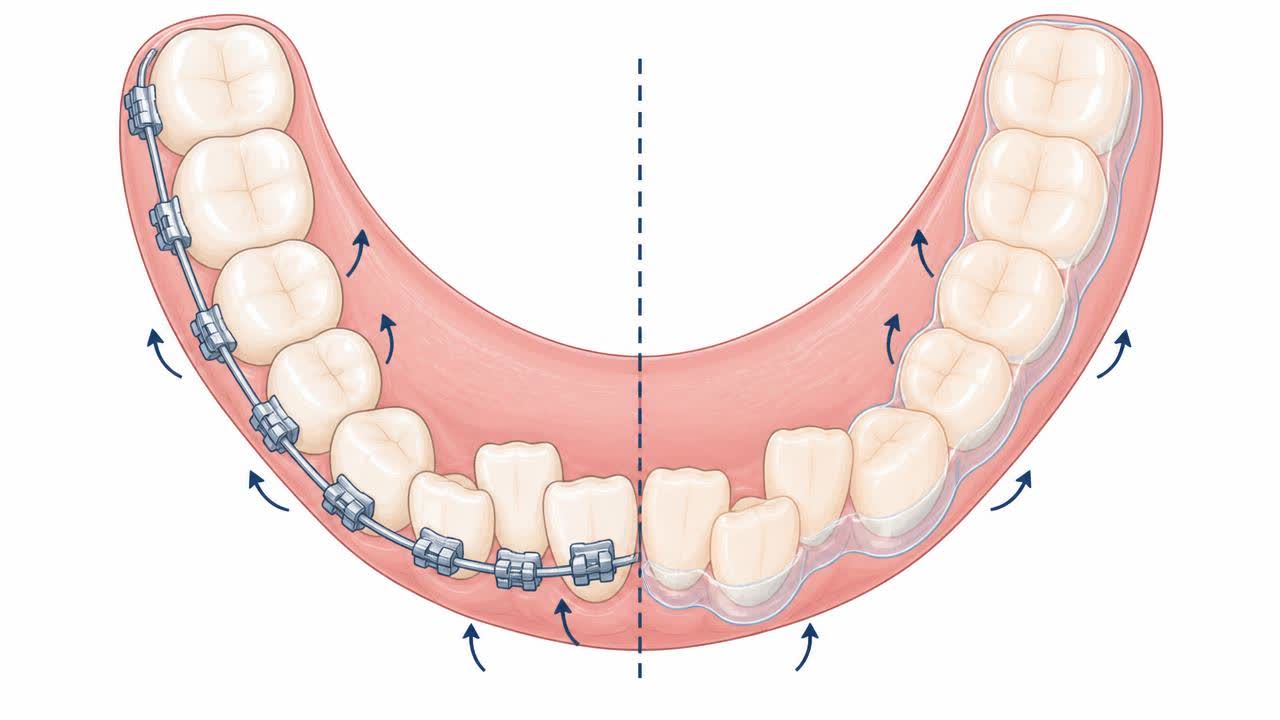
When evaluating invisalign vs metal braces adult treatment pathways, the mechanical delivery of force differs substantially. Traditional fixed appliances utilise stainless steel or nickel-titanium archwires engaged in brackets bonded directly to enamel, delivering continuous, multi-directional force vectors. Clear aligners employ a series of thermoformed medical-grade polyurethane trays that deliver intermittent, displacement-driven forces through engineered contact points and composite resin attachments placed on specific teeth. Both modalities rely on identical cellular physiology, but the force distribution, appliance compliance requirements, and biomechanical efficiency vary significantly between them.
Adult patients frequently present with secondary changes such as missing teeth, drifting, occlusal collapse, or alveolar bone loss. Therefore, before initiating force application through either fixed metal brackets or removable transparent aligners, the clinician must establish that the periodontal apparatus is in a state of absolute health. Applying mechanical pressure to teeth with active, untreated periodontitis accelerates attachment loss and causes irreversible bone destruction, making a thorough baseline periodontal assessment the essential first step in adult orthodontic care.
Aetiology and Indications for Adult Orthodontic Treatment
Adult malocclusion arises from various aetiological factors ranging from developmental discrepancies to acquired dental disease. Primary dental crowding or spacing may persist untreated from childhood, whilst secondary malocclusion often develops over time due to normal physiological mesial drift—the natural tendency of teeth to move forward across the lifespan. Other significant drivers of late-onset alignment issues include unreplaced missing posterior teeth leading to tipping and over-eruption, progressive periodontitis resulting in pathological tooth migration, chronic parafunctional habits such as bruxism or clenching, and relapse following previous adolescent orthodontic treatment due to inadequate long-term retention.
Indications for treatment in adults extend beyond aesthetic enhancement to functional and restorative objectives. Misaligned arches often complicate restorative dentistry, impeding the optimal placement of implants, crowns, or bridges. Crowded anterior teeth create plaque retentive niches that resist standard interdental cleaning, increasing the risk of localised gingival inflammation and proximal caries. Orthodontic alignment is frequently indicated to establish stable intercuspation, correct traumatic deep bites that cause palatal gingival stripping, eliminate anterior crossbites that provoke localised gingival recession, and resolve functional interferences contributing to masticatory muscle fatigue or temporomandibular joint dysfunction.
Clinical Presentation and Diagnostic Manifestations
Malocclusion in adults manifests through several observable clinical signs and subjective symptoms. Patients often report localized food impaction, progressive difficulty with flossing, aesthetic dissatisfaction with visible overlapping or spacing, and uneven tooth wear. Pathological attrition—the loss of hard tooth tissue caused by tooth-to-tooth contact—frequently presents as flattened incisal edges, chipping of anterior restorations, or the development of abfraction lesions at the cervical margins. In cases of severe overbite, the mandibular incisors may impinge directly against the palatal soft tissues, producing ulceration and chronic tissue soreness.
Functional limitations may also include phonetic adaptations, such as difficulty articulating sibilant sounds ('s' and 'z') due to anterior open bites or altered tongue posture. Patients with posterior crossbites or severe bilateral interferences may demonstrate an adaptive mandibular shift during closure, altering the loading dynamics of the temporomandibular joints and masticatory musculature. Visual examination typically reveals altered contact points, irregular gingival zenith lines, asymmetric arch forms, and compromised smile aesthetics characterised by negative dark corridors at the corners of the mouth.
Classification and Case Complexity in Adult Patients
Orthodontic discrepancies are systematically categorised according to Angle’s classification, modified by modern skeletal and transverse criteria. Class I malocclusion involves a normal anteroposterior molar relationship with crowding, spacing, or rotations. Class II malocclusion describes a distal relationship of the mandibular dentition relative to the maxillary arch, presenting either with proclined upper incisors (Division 1) or retroclined central incisors with deep overbites (Division 2). Class III malocclusion involves a mesial relationship where the lower arch is positioned forward relative to the upper arch, frequently resulting in anterior edge-to-edge bites or reverse overjets.
In adult orthodontics, cases are further stratified by biomechanical complexity. Mild cases comprise minor alignment issues, relapses, and minimal spacing requiring less than 4 mm of arch length adjustment. Moderate cases involve root tipping, crossbites, and moderate crowding requiring expansion or planned interproximal reduction. Severe complexity involves premolar extraction space closure, significant skeletal discrepancies, vertical open bites exceeding 3 mm, severe rotations of rounded premolars or canines, and significant root torque demands. Understanding this hierarchy is pivotal when contrasting clear aligner capability against traditional fixed appliance mechanics.
Clear Aligners Versus Metal Braces: Comparative Evidence
When evaluating invisalign vs metal braces adult outcomes, clinical studies demonstrate distinct performance profiles across different types of tooth movement. Traditional fixed metal braces remain the gold standard for complex orthodontic corrections. Because metal brackets and archwires deliver continuous bodily forces directly to the clinical crown and root apex simultaneously, they excel in managing extraction space closure, severe root torque (controlling the angulation of the tooth root within bone), complex multi-tooth extrusions, and severe rotational corrections of cylindrical teeth. Metal appliances operate independently of patient compliance regarding daily wear time.
Conversely, clear aligners offer significant advantages in aesthetics, comfort, and periodontal hygiene. Clear aligners are virtually invisible, making them highly acceptable to adult professionals. Because they are removable, patients can brush and floss without navigating wires and brackets, resulting in lower plaque indices and less gingival inflammation during treatment. Aligners are remarkably effective for resolving mild-to-moderate crowding, closing dental spacing, leveling arches via intrusion of anterior teeth, and tipping crowns into alignment. However, aligner success is entirely dependent upon strict patient adherence to 20 to 22 hours of daily wear.
Where clear aligners face biomechanical limitations is in the precise control of root movements during large translation distances. Without specialised auxiliaries, aligners tend to produce tipping movements rather than pure bodily translation. In severe Class II or Class III surgical-orthodontic cases, or situations requiring extensive premolar extractions, fixed metal braces typically achieve more predictable root parallelism and final occlusal settling. However, advances in hybrid approaches—combining aligners with temporary anchorage devices (TADs), buttons, and elastics—continue to expand the scope of adult clear aligner therapy.
Clinical Workflow and Appointment Expectations
The practical journey for an adult patient undergoing fixed metal braces begins with tooth preparation, involving enamel prophylaxis, acid etching, application of bonding resin, and the precise placement of stainless steel brackets on each tooth. A flexible nickel-titanium initial archwire is engaged with elastomeric or wire ligatures. Adjustment appointments occur every 4 to 8 weeks, during which archwires are progressively changed to thicker, rectangular dimensions to express root torque and control space closure, followed by final detailing with stainless steel wires.
For clear aligners, the clinical workflow starts with an intraoral digital scan and digital prescription. Once the treatment plan is verified by the clinician, custom attachments—small geometric shapes of tooth-coloured composite resin—are bonded to designated teeth using a placement template. These attachments act as handles for the plastic to grip, enabling complex rotational and translational movements. Patients receive a series of sequentially numbered aligners, switching to the next tray every 7 to 14 days according to biological response and tracking efficiency. Follow-up appointments occur every 6 to 10 weeks to monitor aligner fit ('tracking'), perform planned interproximal reduction, and supply subsequent aligner sets.
Complications, Adverse Effects, and Clinical Management
Orthodontic force application carries inherent biological risks regardless of the appliance chosen. Orthodontically induced inflammatory root resorption (OIIRR) involves the microscopic blunting or shortening of root apices; while minor apical remodeling is normal, severe resorption (loss of more than a third of root length) occurs in a small percentage of cases, especially with prolonged treatments or heavy continuous forces. Routine mid-treatment radiographs help monitor root integrity. Soft tissue irritation, including buccal mucosal ulceration and lip chafing, is common with fixed metal brackets and is managed using orthodontic relief wax, whereas aligners occasionally require minor edge-smoothing with an emery board.
Other complications include orthodontic emergency situations such as detached brackets, protruding wire ends impinging on the cheek, or aligner 'non-tracking' where teeth fail to follow the digital template. Non-tracking is addressed through the use of chewies (silicone bite cylinders that fully seat the tray), back-tracking to a previous aligner, or taking a new scan for a mid-course refinement. Periodontal complications, such as gingival recession or loss of interdental papillae ('black triangles'), can occur when teeth with thin gingival biotypes are moved outside the cortical bone envelope, necessitating careful monitoring and sometimes interproximal enamel recontouring to broaden contact points.
Retention Protocols and Long-Term Stability
The completion of active orthodontic tooth movement marks the transition to the retention phase, which is vital for long-term stability. The periodontal ligament fibres and supra-alveolar collagen networks retain mechanical memory and require a minimum of 10 to 12 months to remodel into their new positions. Furthermore, age-related physiological changes continue throughout adult life, meaning that without retention, teeth will inevitably drift. Therefore, retention must be considered an indefinite, life-long commitment for all adult orthodontic patients.
Retention strategies combine fixed and removable modalities. Fixed retainers consist of a thin, passive stainless steel wire bonded to the lingual surfaces of the anterior teeth (typically canine-to-canine in the mandible and incisor-to-incisor in the maxilla), offering continuous protection against anterior crowding relapse. Removable retainers, such as vacuum-formed clear Essix retainers or traditional acrylic-and-wire Hawley retainers, are worn full-time initially and transitioned to night-time-only wear over several months. Adults with bonded retainers require regular hygiene reviews to prevent calculus accumulation around the wire, ensuring long-term periodontal stability.
Evidence and further reading
Mainstream clinical consensus published by organisations including the British Orthodontic Society (BOS), the American Association of Orthodontists (AAO), and independent systematic reviews in the Cochrane Database of Systematic Reviews indicates that both clear aligners and fixed metal braces are effective modalities for managing adult malocclusions, with distinct clinical indications. High-quality trials in the American Journal of Orthodontics and Dentofacial Orthopedics (AJODO) and the Journal of Orthodontics demonstrate that fixed appliances provide superior predictability for complex three-dimensional movements, including root torque, bodily translation across extraction spaces, and severe rotational corrections.
Conversely, systematic reviews in the European Journal of Orthodontics show that clear aligners offer statistically significant benefits regarding periodontal health indices, reduced chairside emergency appointments, and lower incidence of enamel demineralisation during treatment, provided patient compliance exceeds 20 hours per day. Guidance from national health authorities, including the National Institute for Health and Care Excellence (NICE) and the FDI World Dental Federation, emphasizes that successful orthodontic outcomes in adults depend fundamentally on comprehensive pretreatment periodontal stabilization, meticulous biomechanical planning, and sustained retention protocols rather than appliance choice alone.
Oral Hygiene, Dietary Adjustments, and Cultural Context
Maintaining meticulous oral hygiene is paramount during adult orthodontic therapy to prevent enamel demineralisation, manifested as irreversible white spot lesions. Fixed metal braces present significant hygiene challenges: plaque readily accumulates around bracket bases and under archwires. Patients require dedicated hygiene tools, including interdental brushes, single-tufted brushes, orthodontic floss threaders or water flossers, alongside fluoride-containing mouthwashes. Dietary modifications are essential with fixed braces; hard, sticky, or crunchy foods must be avoided to prevent bracket debonding and wire distortion.
Clear aligners permit unrestricted diets because they are removed before eating. However, aligners must never be worn while consuming hot beverages, which warp the thermoplastic material, or sugary and acidic drinks, which seep under the tray and cause rapid, widespread demineralisation. In regions like India and South Asia, dietary and lifestyle habits present unique considerations. Frequent consumption of foods rich in turmeric (curcumin) causes intense yellow staining of clear aligner plastics and aesthetic composite attachments. Furthermore, the use of paan, gutka, or chewing tobacco during orthodontic treatment is strictly contraindicated; these substances not only heavily stain appliances and cause mechanical abrasion, but they also severely compromise periodontal microcirculation, accelerating tissue breakdown during tooth movement.
Questions patients ask us
- Is Invisalign as effective as metal braces for adults?
- For mild to moderate alignment issues, spacing, and arch expansion, clear aligners are comparable in efficacy to metal braces. However, for severe skeletal discrepancies, significant rotations of rounded teeth, and complex premolar extraction spaces requiring substantial root torque, traditional fixed metal braces remain more predictable and biomechanically effective.
- How many hours a day must adult clear aligners be worn?
- Clear aligners must be worn for 20 to 22 hours per day, removed only for meals, hot or sugary drinks, and oral hygiene. Wearing aligners for fewer hours leads to tracking failure, where the teeth do not match the plastic mould, resulting in stalled movement and prolonged treatment times.
- Do adult metal braces cause more pain than clear aligners?
- Both appliances induce mild to moderate aching and pressure discomfort for 2 to 4 days after adjustments or tray changes due to periodontal ligament compression. Metal braces generally cause more soft tissue abrasion to cheeks and lips, whereas clear aligners cause less mucosal irritation but may cause initial tongue soreness.
- Can I get orthodontic treatment if I have crowns or missing teeth?
- Yes. Adult orthodontics frequently accommodates missing teeth, crowns, and implants. Brackets or aligner attachments can be bonded to porcelain crowns using specialised primers. Spaces from missing teeth can be maintained or opened for future implants, or closed using fixed mechanics or aligners with auxiliary anchor devices.
- Why do my clear aligners turn yellow, and how do I prevent it?
- Aligners stain easily when exposed to coloured compounds. Drinking tea, coffee, red wine, or consuming foods seasoned with turmeric while wearing aligners will turn the thermoplastic yellow. Chewing tobacco or paan causes severe dark staining. Always remove aligners before consuming anything other than plain, cool water.
- What are the red flags requiring urgent dental attention during treatment?
- Urgent assessment is required if you experience severe, throbbing pain unrelieved by standard analgesics, significant swelling of the gums or face, unexpected severe tooth mobility, a tooth changing colour to grey or dark brown (suggesting pulpal compromise), or broken wires causing deep mucosal laceration.
- Can adult orthodontic treatment cause gum recession or bone loss?
- If orthodontic forces push a tooth root outside the supportive alveolar bone housing (cortical plate), or if active periodontitis is present during treatment, gum recession and bone loss can occur. Thorough pre-treatment periodontal clearance and controlled biomechanics are critical to minimise these risks.
- Do adults have to wear retainers forever after braces or aligners?
- Yes. Adult bone and periodontal fibres undergo continuous remodeling, and physiological mesial drift naturally moves teeth forward throughout life. Without long-term retention—typically using a combination of night-time removable retainers and fixed bonded wires—relapse and unwanted tooth movement will eventually occur.
Sources and further reading
Guidance from professional and public health bodies. Clinical decisions here are made on your own examination and radiographs.
- 1.Orthodontic treatment and retention — patient resources — American Association of Orthodontists
- 2.Patient information leaflets on appliances and retention — British Orthodontic Society
- 3.Oral health — fact sheet and global status report — World Health Organization
- 4.Policy statements and oral health definitions — FDI World Dental Federation
- 5.Dental health — conditions, treatments and patient guidance — NHS (UK)
- 6.Systematic reviews of oral and dental interventions — Cochrane Oral Health
- 7.Regulatory framework and dental education standards in India — Dental Council of India
When to see us
Get examined without waiting if any of the following applies to you:
- A broken bracket, poking wire or appliance causing ulceration
- A tooth that becomes painful, loose or discoloured during treatment
- Jaw joint pain, locking or a bite that has changed suddenly
Get a written plan and cost before you commit
If this is what you are dealing with, the next step is a consultation with radiographs — orthodontics cases are seen by the specialist who handles that field. You get a written plan and staged cost before anything begins.
reception@dramitsharmahospital.comThis article is general education and does not replace an in-person examination, radiographs or a diagnosis by a qualified dentist.
Clinical terms in this article
Related in Orthodontics
Aligners and Braces: Choosing the Right Option
Metal, ceramic and clear aligner treatment compared, duration, visibility, cost and suitability.
Tooth Extraction for Braces or Severe Crowding Issues
Orthodontic extractions involve the planned removal of select teeth to resolve severe crowding, correct bimaxillary protrusion, and balance dentoalveolar proportions. This clinical guide details diagnostic indications, extraction patterns, procedural steps, recovery, risks, and evidence-based non-extraction alternatives.
Maxillary Osteotomy for Open Bite Alignment and Correction
Maxillary osteotomy for open bite corrects severe vertical skeletal discrepancies through surgical repositioning of the upper jaw. Combined with orthodontics, this procedure restores chewing function, improves speech articulation, and ensures long-term occlusal and facial stability.
Surgically Assisted Rapid Palatal Expansion for Adult Palate Widening
Surgically assisted rapid palatal expansion (SARPE) is a combined orthodontic and surgical treatment designed to correct severe transverse maxillary deficiency in skeletally mature adults, widening the narrow upper jaw to restore functional occlusion, stability, and airway volume.
Surgical Exposure and Bracket Bonding for Impacted Canine Teeth
This clinical guide details impacted canine exposure surgery and bracket bonding. It explains anatomical causes, CBCT diagnostic pathways, open versus closed surgical techniques, orthodontic traction mechanisms, recovery protocols, and evidence-based strategies to manage complications.
Overbite vs Overjet: Key Differences and Correction Methods
This clinical guide clarifies the distinction between overbite (vertical overlap) and overjet (horizontal protrusion). It examines their aetiology, diagnostic pathways, classification, and evidence-based orthodontic and surgical correction methods across paediatric and adult populations.