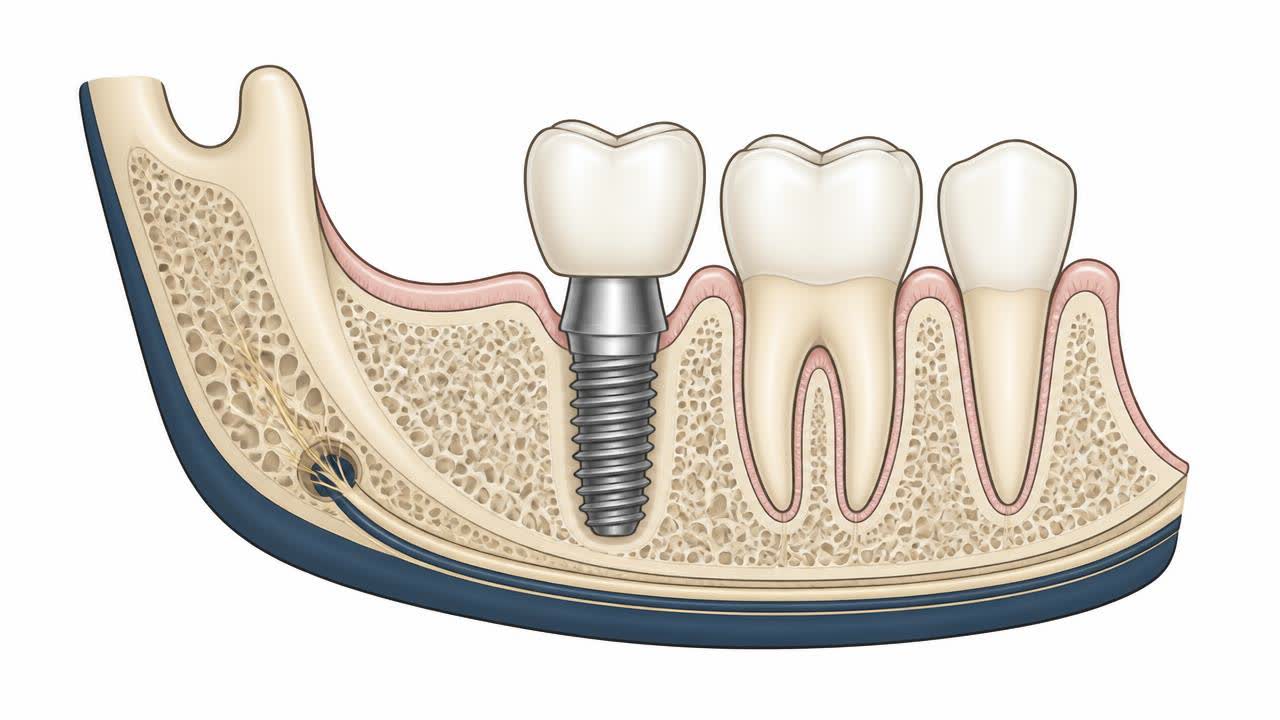
At a glance
- A gap left by a missing tooth affects more than the way a smile looks.
- A denture is a removable appliance that replaces one or more missing teeth, ranging from a small partial denture replacing a few teeth to a complete denture replacing an entire arch.
- A bridge replaces one or more missing teeth by anchoring an artificial tooth to the neighbouring natural teeth on either side of the gap, which are shaped down to accept supporting crowns.
- A dental implant replaces the missing tooth root itself with a titanium or zirconia post placed into the jawbone, onto which a crown, bridge or full-arch prosthesis is fitted once healing is complete.
- The best choice depends on how many teeth are missing, the condition of the remaining teeth and gums, the amount of bone available, general health, and personal priorities such as budget, timeline and preference for a fixed…
Why a missing tooth matters beyond appearance
A gap left by a missing tooth affects more than the way a smile looks. Neighbouring teeth can gradually tilt into the empty space, the tooth in the opposite jaw can over-erupt because it no longer meets resistance when biting, and chewing efficiency drops, sometimes leading people to favour one side of the mouth, which can strain the jaw joint over time.
Underneath the gum, the jawbone that once supported the tooth root begins to resorb once it no longer receives the stimulation of biting forces. This bone loss is gradual but continuous, and it is one of the main reasons replacing a missing tooth sooner rather than later tends to give simpler, more predictable results.
Removable dentures
A denture is a removable appliance that replaces one or more missing teeth, ranging from a small partial denture replacing a few teeth to a complete denture replacing an entire arch. Dentures are the least invasive and generally the most affordable option, requiring no surgery, and modern materials and digital design have made them noticeably more comfortable and natural-looking than older versions.
The main trade-offs are that dentures rest on the gum and jawbone rather than being anchored like a natural root, so they can feel less stable, particularly a lower complete denture, and they need to be removed for cleaning and, usually, overnight. Because they do not stimulate the bone the way a tooth root does, the jawbone under a denture continues to change shape over the years, which is why dentures often need periodic relining or eventual replacement.
Fixed bridges
A bridge replaces one or more missing teeth by anchoring an artificial tooth to the neighbouring natural teeth on either side of the gap, which are shaped down to accept supporting crowns. Bridges are fixed in place, do not need to be removed, and are typically completed faster than implant treatment since there is no waiting period for bone integration.
The main consideration is that healthy neighbouring teeth need to be reduced to support the bridge, which is an irreversible step even when those teeth were otherwise sound. A bridge also does not stimulate the underlying jawbone in the way a natural root or an implant does, so bone changes under the missing tooth site continue over time regardless.
Dental implants
A dental implant replaces the missing tooth root itself with a titanium or zirconia post placed into the jawbone, onto which a crown, bridge or full-arch prosthesis is fitted once healing is complete. Because the implant transmits chewing force into the bone much as a natural root does, it helps preserve the bone's shape and volume over the years, an advantage neither a denture nor a bridge offers.
Implants also avoid the need to prepare or reduce any neighbouring healthy teeth, since each implant stands independently in the bone. The main considerations are the multi-month treatment timeline needed for bone integration, and the need for adequate bone volume at the site, which can sometimes require bone grafting or a sinus lift beforehand if bone has already been lost.
For patients missing several or all of the teeth in a jaw, implant-supported bridges or full-arch solutions such as All-on-4 can replace many teeth using a smaller number of implants, offering a fixed result rather than a removable one.
How the right option is chosen
The best choice depends on how many teeth are missing, the condition of the remaining teeth and gums, the amount of bone available, general health, and personal priorities such as budget, timeline and preference for a fixed versus removable result. A thorough examination, including X-rays or a CT scan where implants are being considered, allows these factors to be weighed together rather than in isolation.
In many cases, more than one option is clinically reasonable, and the decision comes down to a considered conversation about the trade-offs between cost, treatment time, invasiveness and long-term bone health, rather than there being a single universally correct answer.
Questions patients ask us
- What happens if I just leave a missing tooth alone?
- Neighbouring teeth can drift into the gap, the opposing tooth can over-erupt, chewing becomes less efficient, and the underlying jawbone gradually shrinks. These changes tend to make later treatment more involved than if the gap had been addressed earlier.
- Are implants always better than a bridge or denture?
- Implants have advantages for bone preservation and not affecting neighbouring teeth, but they are not automatically the right choice for everyone. Bone availability, healing time, budget and personal preference all factor into which option suits a given situation best.
- Can a denture be upgraded to implants later?
- Yes. Many patients start with a denture and later choose implant-supported options, sometimes converting an existing denture into an implant-retained overdenture that clips securely onto a small number of implants for much greater stability.
- How long does a bridge usually last?
- A well-made bridge with good oral hygiene commonly lasts ten to fifteen years or more, though its lifespan depends heavily on the health of the supporting teeth underneath it.
Sources and further reading
Guidance from professional and public health bodies. Clinical decisions here are made on your own examination and radiographs.
- 1.ITI Treatment Guide series and consensus statements — International Team for Implantology (ITI)
- 2.Consensus reports on implant dentistry — European Association for Osseointegration
- 3.Prosthodontic and edentulous-care patient guidance — American College of Prosthodontists
- 4.Oral health — fact sheet and global status report — World Health Organization
- 5.Policy statements and oral health definitions — FDI World Dental Federation
- 6.Dental health — conditions, treatments and patient guidance — NHS (UK)
- 7.Systematic reviews of oral and dental interventions — Cochrane Oral Health
- 8.Regulatory framework and dental education standards in India — Dental Council of India
When to see us
Get examined without waiting if any of the following applies to you:
- Pain, looseness or pus around an implant or a fixed bridge
- A crown, bridge or denture that has fractured or come away
- Gum swelling that keeps returning around the same restoration
Get a written plan and cost before you commit
If this is what you are dealing with, the next step is a consultation with radiographs — implants & missing teeth cases are seen by the specialist who handles that field. You get a written plan and staged cost before anything begins.
reception@dramitsharmahospital.comThis article is general education and does not replace an in-person examination, radiographs or a diagnosis by a qualified dentist.
Clinical terms in this article
Related in Implants & Missing Teeth
Dental Implants: A Complete Guide
How titanium implants replace missing teeth, who qualifies, the step-by-step timeline and how long they last.
Full Mouth Rehabilitation
Rebuilding a worn, collapsed or heavily damaged dentition with a sequenced, whole-mouth treatment plan.
Peri-Implant Mucositis Symptoms and Early Intervention
Peri-implant mucositis is a plaque-induced, reversible inflammatory lesion affecting the soft tissues surrounding a dental implant without bone loss. Prompt professional debridement, risk-factor modification, and meticulous biofilm control prevent progression to irreversible peri-implantitis.
Peri-Implantitis Symptoms Bone Loss and Implant Salvage
Peri-implantitis is an inflammatory condition causing progressive marginal bone loss around dental implants. Early detection, thorough decontamination, and advanced surgical salvage techniques can arrest bone destruction, resolve inflammation, and preserve implant stability.
Root Canal Retreatment vs Tooth Extraction and Implant
This clinical guide evaluates root canal retreatment versus tooth extraction and dental implant placement. Learn about biological tooth preservation, anatomical considerations, procedural steps, longevity, recovery expectations, and diagnostic criteria to make an informed oral healthcare decision.
Alveolar Ridge Bone Grafting Before Dental Implant Placement
Alveolar ridge bone grafting restores lost jawbone width and height before dental implant placement. This evidence-based guide covers biological principles, diagnostic imaging, surgical techniques, biomaterial choices, postoperative recovery, potential complications, and clinical considerations.