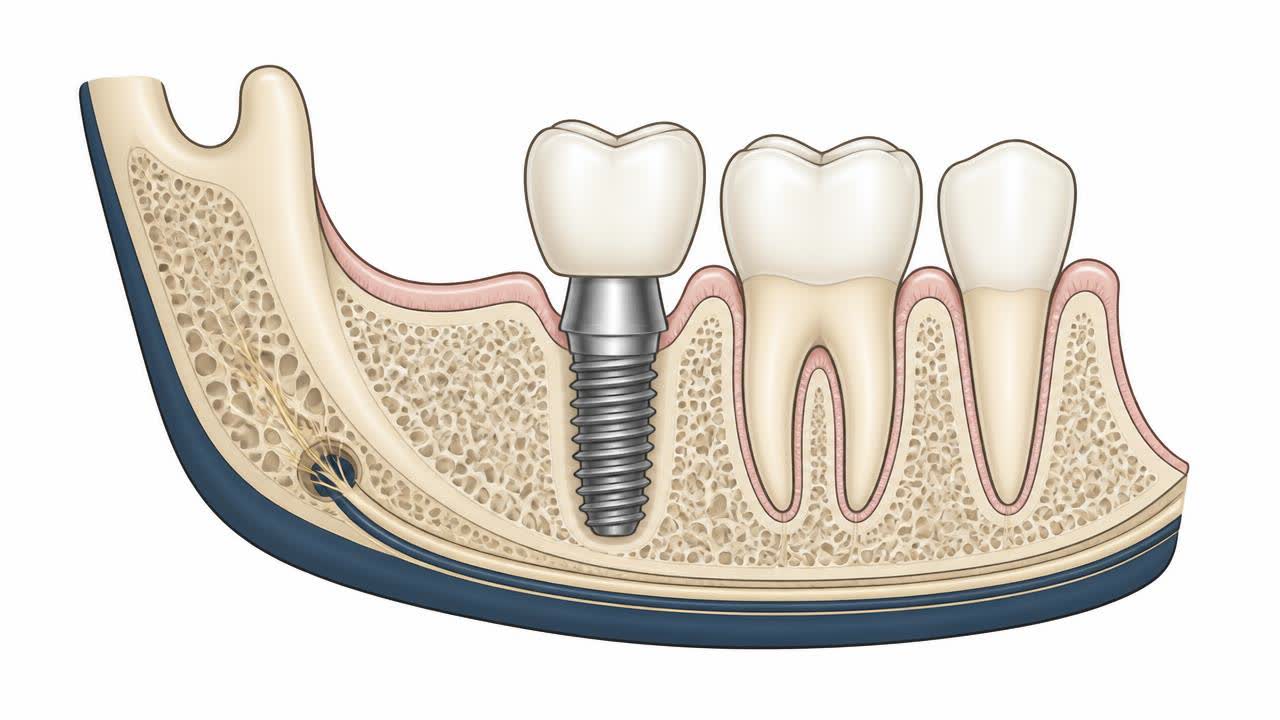
At a glance
- A dental implant is a medical-grade titanium or zirconia screw placed into the jawbone to act as an artificial tooth root.
- Most adults with one or more missing teeth and reasonable general health are candidates.
- The process generally follows five stages.
- Implants are cleaned essentially like natural teeth: brushing twice daily, using interdental brushes or a water flosser around the crown margin, and attending a professional check every six months.
- A single missing tooth is typically replaced with one implant and one crown.
What is a dental implant?
A dental implant is a medical-grade titanium or zirconia screw placed into the jawbone to act as an artificial tooth root. Once the bone fuses to its surface, a biological process called osseointegration, a custom crown, bridge or full-arch prosthesis is fixed on top. This fusion typically takes several weeks to a few months, during which the bone cells grow directly against the implant surface, creating a bond strong enough to bear normal chewing forces for decades.
Unlike a conventional bridge, an implant does not require grinding down healthy neighbouring teeth, and unlike a removable denture it transmits chewing force into the bone, which helps preserve the jaw's shape over the years. This is an important distinction because bone that is no longer stimulated by a tooth root gradually resorbs, changing the shape of the face and making dentures progressively looser and less comfortable over time.
Modern implants are manufactured with precisely engineered surface textures that encourage faster and stronger bone attachment than the earliest implant designs from decades ago. This means treatment timelines have shortened considerably, and predictability has improved across almost every category of patient, from a single missing tooth to a fully edentulous jaw.
Who is a suitable candidate?
Most adults with one or more missing teeth and reasonable general health are candidates. What matters most is bone volume at the intended site, the condition of the surrounding gum tissue, and whether systemic conditions such as diabetes or osteoporosis are well controlled. Age itself is rarely a barrier; healthy bone at seventy behaves much like healthy bone at forty for implant purposes.
Where bone has resorbed after long-term tooth loss, grafting, a sinus lift, or specialised zygomatic implants can still make treatment possible even in cases that were once considered untreatable. A cone-beam CT scan is used to measure available bone in three dimensions before any decision is made, allowing the surgical plan to be rehearsed digitally before a single incision is made in the mouth.
Active smoking, uncontrolled diabetes and untreated gum disease all reduce implant success rates measurably and are addressed before surgery wherever possible. Smoking in particular slows healing and roughly doubles the risk of early implant failure, so a temporary reduction or cessation programme is often recommended around the time of surgery.
Patients on certain bone-affecting medications, such as some osteoporosis drugs, require a careful risk assessment beforehand, and this is discussed openly during the consultation so that expectations are realistic from the outset.
The treatment journey
The process generally follows five stages. First, a consultation, CBCT scan and digital treatment plan establish exactly where and at what angle the implant will sit. Second, the implant is placed under local anaesthesia, a procedure that usually takes thirty to sixty minutes per implant and is far less uncomfortable than most patients expect. Third, a healing period of eight to twelve weeks allows the bone to integrate fully around the implant surface.
Fourth, once integration is confirmed, an impression or digital intraoral scan captures the precise position of the implant so the final restoration fits with millimetre accuracy. Fifth, the definitive crown, bridge or denture is fitted, adjusted for bite and polished. Each stage is checked clinically and, where needed, radiographically before moving to the next.
In selected cases with good bone quality and primary stability at the time of placement, immediate loading is possible, meaning a temporary tooth can be fitted on the very same day as surgery. This is particularly valued by patients who cannot be seen with a visible gap, though the final restoration still waits until integration is complete.
Single tooth, bridge or full arch
A single missing tooth is typically replaced with one implant and one crown. Several missing teeth in a row can be replaced with an implant-supported bridge, which often needs fewer implants than there are missing teeth because the bridge spans between two or more fixture points.
For patients missing all their teeth in a jaw, full-arch solutions such as All-on-4 or All-on-6 use four to six strategically angled implants to support an entire fixed arch of teeth, avoiding the bulk and instability of a traditional full denture while often being completed in a shorter overall timeframe than replacing each tooth individually.
Aftercare and longevity
Implants are cleaned essentially like natural teeth: brushing twice daily, using interdental brushes or a water flosser around the crown margin, and attending a professional check every six months. Because implants have no nerve inside them, they cannot develop decay, but the gum around them can still become inflamed if plaque is left to accumulate, a condition known as peri-implantitis.
With good hygiene and regular professional review, implant survival rates beyond ten years are consistently reported above ninety-five percent in the dental literature, making them one of the most predictable treatments in modern dentistry. Long-term success depends far more on maintenance than on the initial surgery itself.
Grinding habits, a poorly adjusted bite, or skipped maintenance visits are the most common reasons an otherwise successful implant runs into trouble later, which is why the review schedule recommended by your dentist should be followed even when everything feels perfectly comfortable.
Questions patients ask us
- Is implant surgery painful?
- The procedure itself is done under local anaesthesia and is not painful. Mild soreness for two to three days afterwards is normal and is managed comfortably with routine painkillers and simple aftercare measures such as cold compresses.
- How long does the full treatment take?
- Typically three to four months from placement to the final crown, allowing time for the bone to integrate. This can extend to six months or more if bone grafting or a sinus lift is required beforehand.
- Can I get all my teeth on implants?
- Yes. Full-arch rehabilitation such as All-on-4 or All-on-6 replaces an entire jaw of teeth using only four to six implants, giving a fixed, non-removable result rather than a conventional denture.
- What happens if I do not replace a missing tooth?
- Neighbouring teeth can tilt into the gap, the opposing tooth can over-erupt, and the underlying bone gradually shrinks. Replacing a missing tooth promptly with an implant helps prevent this chain of changes.
- Do implants need to be replaced over time?
- The titanium implant itself is designed to last indefinitely once integrated. The crown on top, like a natural tooth crown, may need eventual replacement after many years of normal wear.
Sources and further reading
Guidance from professional and public health bodies. Clinical decisions here are made on your own examination and radiographs.
- 1.ITI Treatment Guide series and consensus statements — International Team for Implantology (ITI)
- 2.Consensus reports on implant dentistry — European Association for Osseointegration
- 3.Prosthodontic and edentulous-care patient guidance — American College of Prosthodontists
- 4.Oral health — fact sheet and global status report — World Health Organization
- 5.Policy statements and oral health definitions — FDI World Dental Federation
- 6.Dental health — conditions, treatments and patient guidance — NHS (UK)
- 7.Systematic reviews of oral and dental interventions — Cochrane Oral Health
- 8.Regulatory framework and dental education standards in India — Dental Council of India
When to see us
Get examined without waiting if any of the following applies to you:
- Pain, looseness or pus around an implant or a fixed bridge
- A crown, bridge or denture that has fractured or come away
- Gum swelling that keeps returning around the same restoration
Get a written plan and cost before you commit
If this is what you are dealing with, the next step is a consultation with radiographs — implants & missing teeth cases are seen by the specialist who handles that field. You get a written plan and staged cost before anything begins.
reception@dramitsharmahospital.comThis article is general education and does not replace an in-person examination, radiographs or a diagnosis by a qualified dentist.
Clinical terms in this article
Related in Implants & Missing Teeth
Missing Teeth: Comparing Dentures, Bridges and Implant Options
What happens if a missing tooth is left unreplaced, and how dentures, bridges and implants compare on comfort, longevity and bone health.
Full Mouth Rehabilitation
Rebuilding a worn, collapsed or heavily damaged dentition with a sequenced, whole-mouth treatment plan.
Peri-Implant Mucositis Symptoms and Early Intervention
Peri-implant mucositis is a plaque-induced, reversible inflammatory lesion affecting the soft tissues surrounding a dental implant without bone loss. Prompt professional debridement, risk-factor modification, and meticulous biofilm control prevent progression to irreversible peri-implantitis.
Peri-Implantitis Symptoms Bone Loss and Implant Salvage
Peri-implantitis is an inflammatory condition causing progressive marginal bone loss around dental implants. Early detection, thorough decontamination, and advanced surgical salvage techniques can arrest bone destruction, resolve inflammation, and preserve implant stability.
Root Canal Retreatment vs Tooth Extraction and Implant
This clinical guide evaluates root canal retreatment versus tooth extraction and dental implant placement. Learn about biological tooth preservation, anatomical considerations, procedural steps, longevity, recovery expectations, and diagnostic criteria to make an informed oral healthcare decision.
Alveolar Ridge Bone Grafting Before Dental Implant Placement
Alveolar ridge bone grafting restores lost jawbone width and height before dental implant placement. This evidence-based guide covers biological principles, diagnostic imaging, surgical techniques, biomaterial choices, postoperative recovery, potential complications, and clinical considerations.