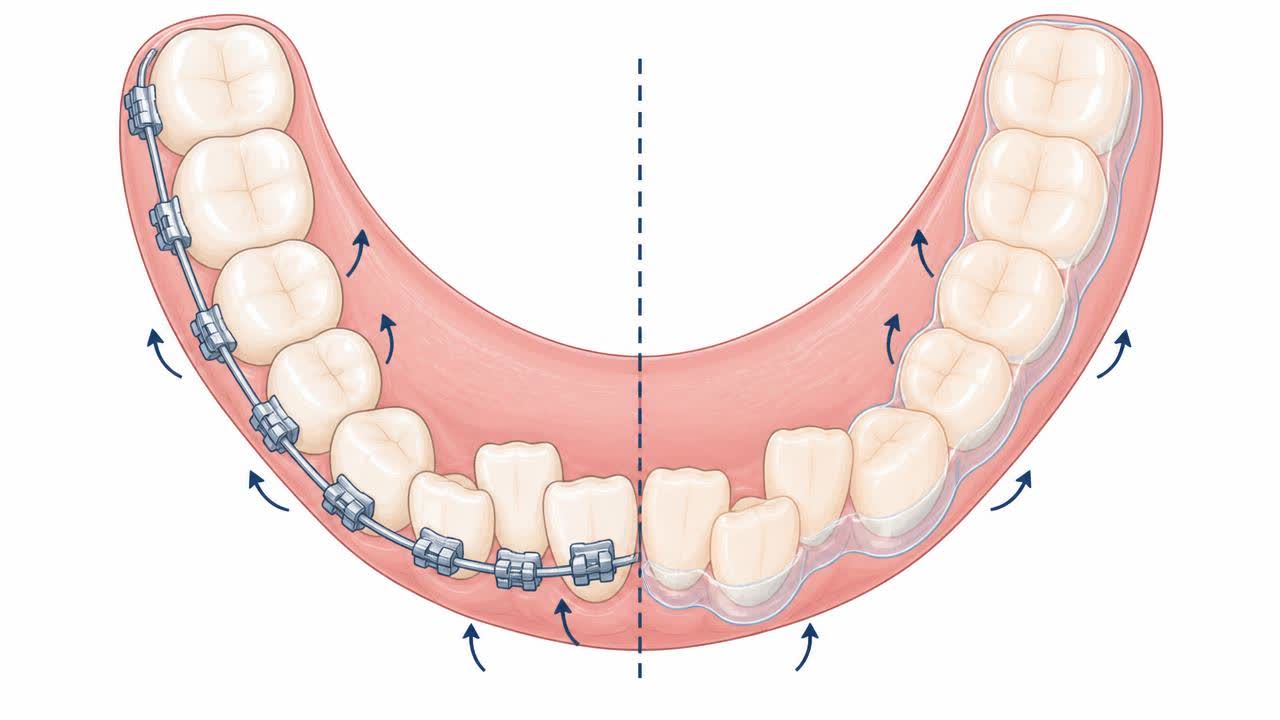
At a glance
- Teeth crowding occurs when there is simply not enough space in your jaw for all your teeth to fit comfortably in a straight line.
- The success of correcting crowding starts with our 3D digital treatment planning.
- To resolve crowding, we may need to create extra space.
- As you progress through your series of aligners, you will see your teeth slowly but surely un-crowding.
- Once your teeth are straightened and the crowding is resolved, we will ensure that your new, perfect smile stays that way.
How Aligners Fix Crowding
Teeth crowding occurs when there is simply not enough space in your jaw for all your teeth to fit comfortably in a straight line. This often results in teeth that are rotated, overlapped, or pushed forward and back. Clear aligners correct this by applying precise, incremental pressure to specific teeth, gradually moving them into their ideal positions and effectively expanding the arch where necessary.
Through a sequence of custom-made trays, we can rotate, tilt, and bodily shift teeth to create the perfect amount of space. Whether your crowding is minor or more significant, clear aligners use sophisticated digital planning to ensure that each tooth moves along its own optimal path. This results in a stable, functional, and aesthetically pleasing smile, all without the need for traditional, bulky metal braces.
Digital Planning for Success
The success of correcting crowding starts with our 3D digital treatment planning. We capture a detailed scan of your dental anatomy and use advanced software to simulate your teeth moving from their crowded state to their final, aligned positions. This digital roadmap allows us to visualise every step of the process and calculate the exact amount of space required for every single tooth.
Because the treatment is planned so carefully in advance, we can predict how your teeth will move and how the crowding will be resolved. This level of precision gives you the confidence to know that your smile is being transformed based on a highly accurate plan tailored specifically to you. Our team at Dr. Amit Sharma Super Speciality Dental Hospital will show you this plan during your consultation.
Creating Space Effectively
To resolve crowding, we may need to create extra space. Depending on your specific case, we might use techniques such as Interproximal Reduction (IPR), which involves gently polishing a tiny amount of enamel from between the teeth, or we may use expansion, where the dental arch is gently widened. These methods allow us to resolve even moderate to severe crowding without the need for extracting healthy permanent teeth.
Our goal is always to achieve the best results while preserving your natural tooth structure. By using these advanced, non-invasive techniques, we can effectively create the space needed to align your teeth properly. This approach is not only efficient but also ensures that your final smile looks natural, healthy, and perfectly balanced, which is our top priority in every orthodontic case we treat.
The Treatment Journey
As you progress through your series of aligners, you will see your teeth slowly but surely un-crowding. It is incredibly rewarding to notice these changes as you change your trays at the prescribed intervals. Because the movement is incremental, the process is comfortable, and you can easily maintain your oral hygiene throughout, which is often much more challenging with traditional braces that can trap food.
You will have regular check-ups with our team to ensure your teeth are tracking perfectly along the plan. These visits are essential for monitoring the movement and ensuring that the space-creation techniques are working effectively. Your commitment to wearing the aligners as prescribed is what will power this transformation, and we are here to support you at every single step of your journey.
Long-Term Stability
Once your teeth are straightened and the crowding is resolved, we will ensure that your new, perfect smile stays that way. This is achieved through the use of retainers, which you will wear after your active treatment is finished. Retainers are a crucial part of preventing your teeth from relapsing back to their original crowded state and are essential for your long-term success.
At Dr. Amit Sharma Super Speciality Dental Hospital, we believe in a comprehensive approach that includes not just fixing the crowding, but also ensuring your bite is stable and your oral health is maintained for life. By following our post-treatment retention advice, you can enjoy your straight, healthy, and beautiful smile for many years to come. We are proud to help you achieve the results you deserve.
Questions patients ask us
- Can aligners fix severe crowding?
- Clear aligners are surprisingly versatile and can effectively treat many cases of crowding. During your initial consultation, we will assess your specific alignment and advise if clear aligners are the ideal treatment for your needs.
- Do I need teeth removed for crowding?
- Not necessarily. Modern techniques like IPR and arch expansion allow us to create space for most patients without the need to extract healthy permanent teeth. We always aim to keep your natural teeth whenever possible.
- How long does it take to fix crowding with aligners?
- The treatment time depends entirely on the severity of the crowding and your compliance with wearing your aligners as directed. We will provide a personal treatment timeline estimate after your initial clinical scan.
- Will my teeth stay straight after the crowding is fixed?
- Yes, provided you wear your retainers as prescribed. Retainers are essential to keep your teeth in their new positions after treatment and to prevent the natural tendency for teeth to shift back over time.
Sources and further reading
Guidance from professional and public health bodies. Clinical decisions here are made on your own examination and radiographs.
- 1.Orthodontic treatment and retention — patient resources — American Association of Orthodontists
- 2.Patient information leaflets on appliances and retention — British Orthodontic Society
- 3.Oral health — fact sheet and global status report — World Health Organization
- 4.Policy statements and oral health definitions — FDI World Dental Federation
- 5.Dental health — conditions, treatments and patient guidance — NHS (UK)
- 6.Systematic reviews of oral and dental interventions — Cochrane Oral Health
- 7.Regulatory framework and dental education standards in India — Dental Council of India
When to see us
Get examined without waiting if any of the following applies to you:
- A broken bracket, poking wire or appliance causing ulceration
- A tooth that becomes painful, loose or discoloured during treatment
- Jaw joint pain, locking or a bite that has changed suddenly
Get a written plan and cost before you commit
If this is what you are dealing with, the next step is a consultation with radiographs — orthodontics cases are seen by the specialist who handles that field. You get a written plan and staged cost before anything begins.
reception@dramitsharmahospital.comThis article is general education and does not replace an in-person examination, radiographs or a diagnosis by a qualified dentist.
Clinical terms in this article
Related in Orthodontics
Aligners and Braces: Choosing the Right Option
Metal, ceramic and clear aligner treatment compared, duration, visibility, cost and suitability.
Tooth Extraction for Braces or Severe Crowding Issues
Orthodontic extractions involve the planned removal of select teeth to resolve severe crowding, correct bimaxillary protrusion, and balance dentoalveolar proportions. This clinical guide details diagnostic indications, extraction patterns, procedural steps, recovery, risks, and evidence-based non-extraction alternatives.
Maxillary Osteotomy for Open Bite Alignment and Correction
Maxillary osteotomy for open bite corrects severe vertical skeletal discrepancies through surgical repositioning of the upper jaw. Combined with orthodontics, this procedure restores chewing function, improves speech articulation, and ensures long-term occlusal and facial stability.
Surgically Assisted Rapid Palatal Expansion for Adult Palate Widening
Surgically assisted rapid palatal expansion (SARPE) is a combined orthodontic and surgical treatment designed to correct severe transverse maxillary deficiency in skeletally mature adults, widening the narrow upper jaw to restore functional occlusion, stability, and airway volume.
Surgical Exposure and Bracket Bonding for Impacted Canine Teeth
This clinical guide details impacted canine exposure surgery and bracket bonding. It explains anatomical causes, CBCT diagnostic pathways, open versus closed surgical techniques, orthodontic traction mechanisms, recovery protocols, and evidence-based strategies to manage complications.
Overbite vs Overjet: Key Differences and Correction Methods
This clinical guide clarifies the distinction between overbite (vertical overlap) and overjet (horizontal protrusion). It examines their aetiology, diagnostic pathways, classification, and evidence-based orthodontic and surgical correction methods across paediatric and adult populations.