At a glance
- Metal braces are the most efficient and economical orthodontic option, and they handle the widest range of complex tooth and jaw movements reliably.
- Mild crowding or spacing typically resolves in six to ten months.
- Crowded teeth trap plaque in overlapping surfaces that a toothbrush and floss struggle to reach, raising the long-term risk of decay and gum disease in those specific areas.
- The right choice depends on the complexity of the case, personal preference regarding visibility, and how disciplined a person can realistically be with a removable appliance.
- Teeth have a lifelong tendency to drift back towards their original position once active treatment stops, a process called relapse.
The three main options
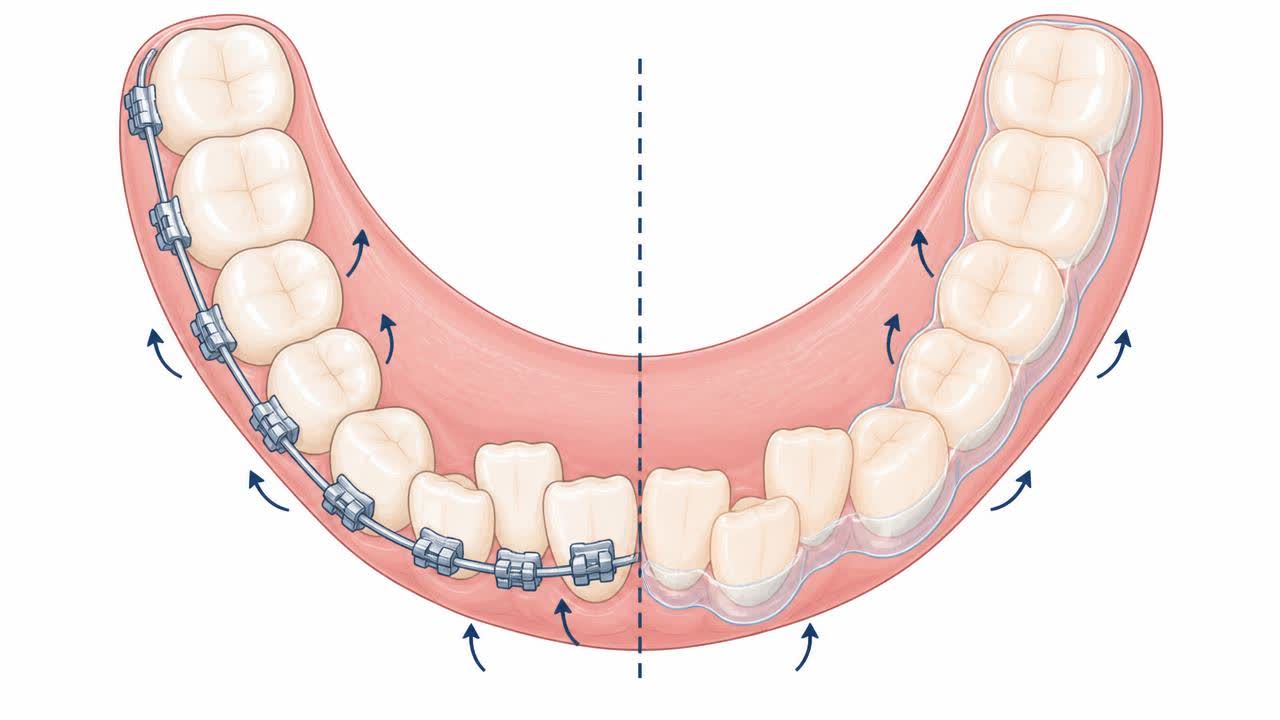
Metal braces are the most efficient and economical orthodontic option, and they handle the widest range of complex tooth and jaw movements reliably. They consist of brackets bonded to each tooth connected by an archwire, adjusted periodically to guide teeth into position.
Ceramic braces work in an identical way to metal braces but use tooth-coloured or clear brackets for greater discretion, making them popular with adults who want effective treatment without the same visibility as traditional metal.
Clear aligners are a series of removable, transparent trays, each worn for one to two weeks before progressing to the next in the sequence, gradually moving teeth according to a digital plan mapped out from the very first scan.
How long treatment takes
Mild crowding or spacing typically resolves in six to ten months. Moderate cases involving more significant rotation or gaps generally take twelve to eighteen months. Complex bite correction or cases requiring surgical input can extend to eighteen to thirty months or longer.
Aligners require twenty to twenty-two hours of daily wear to move teeth on schedule; removing them for meals and brushing is fine, but extended time out of the mouth, such as forgetting to wear them for a full day, slows progress. Compliance, more than the appliance chosen, decides how quickly treatment finishes.
Why alignment is not only cosmetic
Crowded teeth trap plaque in overlapping surfaces that a toothbrush and floss struggle to reach, raising the long-term risk of decay and gum disease in those specific areas. Straightening the teeth makes daily cleaning significantly easier and more effective.
An uneven bite can also cause abnormal, uneven wear on specific teeth, place strain on the jaw joint, and contribute to headaches or jaw muscle tension in some patients. Correcting the bite addresses these functional issues alongside the visible improvement in alignment.
Choosing between the options
The right choice depends on the complexity of the case, personal preference regarding visibility, and how disciplined a person can realistically be with a removable appliance. A thorough examination, models or scans, and photographs allow the orthodontic team to recommend the most predictable route rather than simply the most requested one.
Some cases genuinely require fixed braces to achieve the planned result reliably, while others are equally well suited to aligners; an honest assessment at the outset avoids switching approaches partway through treatment.
Retainers after treatment
Teeth have a lifelong tendency to drift back towards their original position once active treatment stops, a process called relapse. A fixed retainer bonded behind the front teeth, a removable retainer worn at night, or both together, is not an optional extra but the mechanism that protects the result for life.
Questions patients ask us
- Am I too old for braces?
- No. Orthodontic tooth movement works at any age provided the gums and supporting bone are healthy, and a growing number of adult patients undergo treatment successfully every year.
- Do braces or aligners hurt?
- Some pressure and mild discomfort for a few days after each adjustment or new aligner is normal as teeth begin to move, but this is manageable with routine painkillers and settles quickly.
- Can I eat normally with aligners?
- Aligners are removed for eating and drinking anything other than water, so there are no food restrictions, unlike fixed braces which require avoiding hard and sticky foods.
- What happens if I stop wearing my retainer?
- Teeth can begin shifting back towards their original position within months of stopping retainer wear, which is why long-term or indefinite retention is generally recommended.
Sources and further reading
Guidance from professional and public health bodies. Clinical decisions here are made on your own examination and radiographs.
- 1.Orthodontic treatment and retention — patient resources — American Association of Orthodontists
- 2.Patient information leaflets on appliances and retention — British Orthodontic Society
- 3.Oral health — fact sheet and global status report — World Health Organization
- 4.Policy statements and oral health definitions — FDI World Dental Federation
- 5.Dental health — conditions, treatments and patient guidance — NHS (UK)
- 6.Systematic reviews of oral and dental interventions — Cochrane Oral Health
- 7.Regulatory framework and dental education standards in India — Dental Council of India
When to see us
Get examined without waiting if any of the following applies to you:
- A broken bracket, poking wire or appliance causing ulceration
- A tooth that becomes painful, loose or discoloured during treatment
- Jaw joint pain, locking or a bite that has changed suddenly
Get a written plan and cost before you commit
If this is what you are dealing with, the next step is a consultation with radiographs — orthodontics cases are seen by the specialist who handles that field. You get a written plan and staged cost before anything begins.
reception@dramitsharmahospital.comThis article is general education and does not replace an in-person examination, radiographs or a diagnosis by a qualified dentist.
Clinical terms in this article
Related in Orthodontics
Tooth Extraction for Braces or Severe Crowding Issues
Orthodontic extractions involve the planned removal of select teeth to resolve severe crowding, correct bimaxillary protrusion, and balance dentoalveolar proportions. This clinical guide details diagnostic indications, extraction patterns, procedural steps, recovery, risks, and evidence-based non-extraction alternatives.
Maxillary Osteotomy for Open Bite Alignment and Correction
Maxillary osteotomy for open bite corrects severe vertical skeletal discrepancies through surgical repositioning of the upper jaw. Combined with orthodontics, this procedure restores chewing function, improves speech articulation, and ensures long-term occlusal and facial stability.
Surgically Assisted Rapid Palatal Expansion for Adult Palate Widening
Surgically assisted rapid palatal expansion (SARPE) is a combined orthodontic and surgical treatment designed to correct severe transverse maxillary deficiency in skeletally mature adults, widening the narrow upper jaw to restore functional occlusion, stability, and airway volume.
Surgical Exposure and Bracket Bonding for Impacted Canine Teeth
This clinical guide details impacted canine exposure surgery and bracket bonding. It explains anatomical causes, CBCT diagnostic pathways, open versus closed surgical techniques, orthodontic traction mechanisms, recovery protocols, and evidence-based strategies to manage complications.
Overbite vs Overjet: Key Differences and Correction Methods
This clinical guide clarifies the distinction between overbite (vertical overlap) and overjet (horizontal protrusion). It examines their aetiology, diagnostic pathways, classification, and evidence-based orthodontic and surgical correction methods across paediatric and adult populations.
Deep Bite: Symptoms, Dental Complications, and Treatment Options
A deep bite occurs when upper front teeth excessively overlap the lower teeth. This comprehensive clinical guide covers causes, traumatic complications, diagnostic methods, evidence-based orthodontic and surgical corrections, retention protocols, and guidance on when to seek urgent dental care.