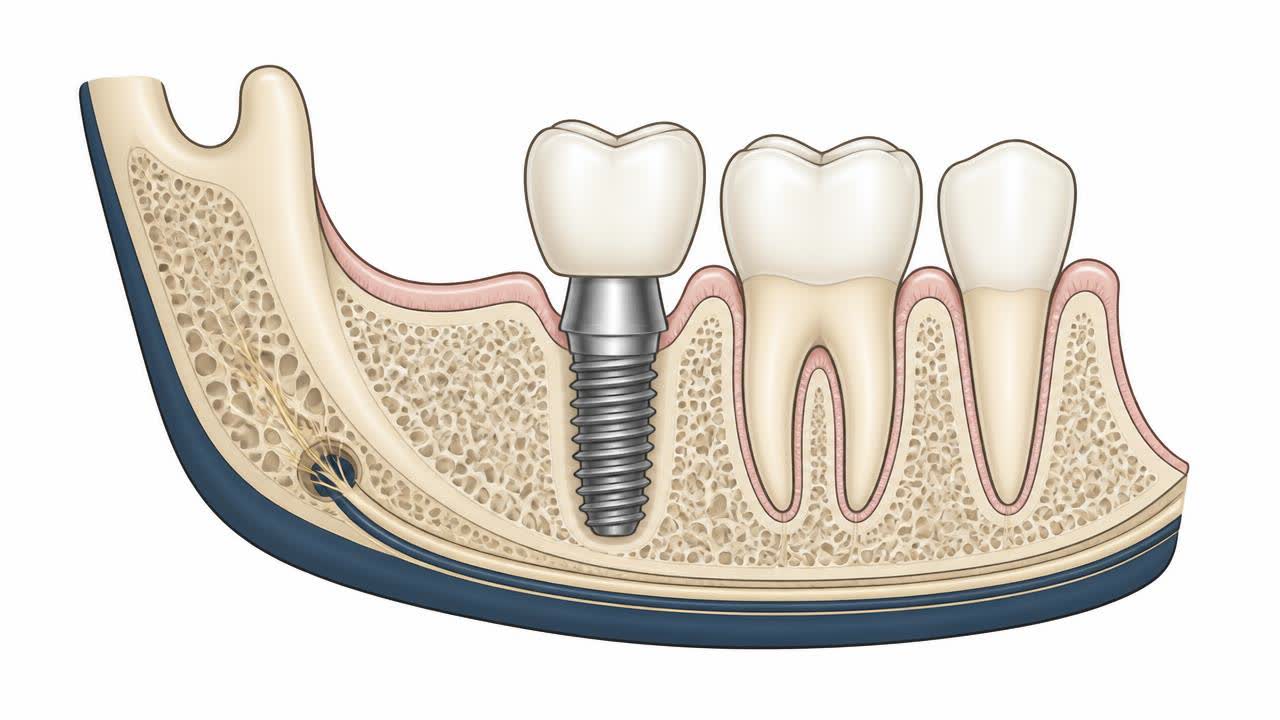
At a glance
- When an implant crown is placed, it must be securely attached to the implant abutment.
- A screw-retained crown features a small access hole on the biting surface, allowing a technician to screw the crown directly into the implant.
- Cement-retained crowns are attached by bonding the crown to an abutment using a specialised dental cement.
- The choice between screw-retained and cement-retained depends on several factors, including the position of the implant in the jaw.
- Regardless of the method chosen, the primary goal is a restoration that is stable, easy to keep clean, and aesthetically pleasing.
The Role of Crown Attachment
When an implant crown is placed, it must be securely attached to the implant abutment. There are two primary methods for this: screw-retained and cement-retained. The choice between these two affects how the crown is maintained, its ease of removal for future adjustments, and the risk of complications related to residual cement. Understanding these differences helps you better appreciate the steps your dentist takes to ensure your restoration is secure.
Each technique has specific clinical indications. Screw-retained crowns are directly bolted to the implant, while cement-retained crowns are bonded onto a custom abutment. The decision depends on factors like the amount of space available, the angle of the implant, and the dentist's preference for future serviceability. Both methods can be highly successful, but they offer different advantages for long-term care and maintenance of your dental implant.
Screw-Retained Crowns
A screw-retained crown features a small access hole on the biting surface, allowing a technician to screw the crown directly into the implant. This method offers excellent retrievability. If the crown needs to be removed for professional cleaning, repair, or to tighten the internal components, it can be easily taken off by accessing the screw channel, which is then sealed with a temporary filling material.
The main benefit of this approach is the total absence of cement. In traditional crown work, excess cement can sometimes be pushed under the gums, where it becomes difficult to remove. Over time, trapped cement can cause inflammation and peri-implantitis. With a screw-retained crown, this specific risk is eliminated, making it a preferred choice for many clinical scenarios, especially when long-term maintenance ease is a priority for the patient.
Cement-Retained Crowns
Cement-retained crowns are attached by bonding the crown to an abutment using a specialised dental cement. This method often allows for better aesthetic control, as the crown can be designed without an access hole on the surface. This creates a seamless, natural look that is particularly beneficial for front teeth where a screw access hole might otherwise interfere with the appearance of the restoration.
While they look fantastic, cement-retained crowns require extreme precision during the bonding process. The dentist must ensure that no excess cement is left behind, as it can irritate the delicate gum tissue and potentially lead to bone loss around the implant over time. Our team takes meticulous care to manage this process, often using custom abutments that raise the margin of the crown to a level where cleanup is straightforward.
Clinical Selection Factors
The choice between screw-retained and cement-retained depends on several factors, including the position of the implant in the jaw. If the implant is angled in a way that makes an access hole visible, a cement-retained crown might be chosen for better aesthetics. Conversely, if the implant is placed in an ideal position, a screw-retained crown is often favoured for its simplicity and the ability to easily retrieve it in the future.
Another factor is the amount of available space. Screw-retained crowns require a specific amount of height to accommodate the screw and access channel. If the space is very limited, a custom abutment with a cemented crown might be the only viable solution. Your dentist will carefully evaluate your specific anatomy and the implant position to determine which attachment method will provide the most reliable and aesthetic result for you.
Prioritising Your Long-Term Health
Regardless of the method chosen, the primary goal is a restoration that is stable, easy to keep clean, and aesthetically pleasing. Both screw-retained and cement-retained crowns have been used successfully for millions of implants worldwide. The key to success is meticulous planning, precise clinical execution, and your commitment to excellent daily oral hygiene and regular dental check-ups to monitor the health of your restoration.
By choosing an experienced dental team, you ensure that your implant crown is designed and attached using the best clinical practices. We prioritise your long-term health by considering all factors, including the accessibility of the restoration for future maintenance. We invite you to discuss any concerns you may have about your treatment plan so that you feel fully informed and confident about your dental implant journey.
Questions patients ask us
- What are the main advantages of screw-retained crowns?
- The biggest advantage is retrievability. They can be easily removed for maintenance, repair, or cleaning without damaging the crown. They also eliminate the risk of residual cement becoming trapped under the gum tissue, which is a major benefit for long-term health.
- Is a cement-retained crown less durable?
- No, a well-placed cement-retained crown is very durable. The primary risk associated with them is the potential for excess cement left behind during placement. By using custom-designed abutments and rigorous cleaning techniques, we can minimise these risks, ensuring a long-lasting and healthy result for the patient.
- Which one looks more natural?
- Cement-retained crowns often offer better aesthetics because they do not have an access hole on the surface. This is particularly useful for front teeth where every detail matters for a natural appearance. However, skilled technicians can also make screw-retained crowns look very natural by carefully concealing the screw access channel.
- How often do these crowns need to be serviced?
- With good oral hygiene, these crowns can last for many years without needing major service. Regular check-ups allow us to inspect the integrity of the crown and the health of the surrounding gums, catching any minor issues early before they develop into more significant problems.
Sources and further reading
Guidance from professional and public health bodies. Clinical decisions here are made on your own examination and radiographs.
- 1.ITI Treatment Guide series and consensus statements — International Team for Implantology (ITI)
- 2.Consensus reports on implant dentistry — European Association for Osseointegration
- 3.Prosthodontic and edentulous-care patient guidance — American College of Prosthodontists
- 4.Oral health — fact sheet and global status report — World Health Organization
- 5.Policy statements and oral health definitions — FDI World Dental Federation
- 6.Dental health — conditions, treatments and patient guidance — NHS (UK)
- 7.Systematic reviews of oral and dental interventions — Cochrane Oral Health
- 8.Regulatory framework and dental education standards in India — Dental Council of India
When to see us
Get examined without waiting if any of the following applies to you:
- Pain, looseness or pus around an implant or a fixed bridge
- A crown, bridge or denture that has fractured or come away
- Gum swelling that keeps returning around the same restoration
Get a written plan and cost before you commit
If this is what you are dealing with, the next step is a consultation with radiographs — implants & missing teeth cases are seen by the specialist who handles that field. You get a written plan and staged cost before anything begins.
reception@dramitsharmahospital.comThis article is general education and does not replace an in-person examination, radiographs or a diagnosis by a qualified dentist.
Clinical terms in this article
Related in Implants & Missing Teeth
Missing Teeth: Comparing Dentures, Bridges and Implant Options
What happens if a missing tooth is left unreplaced, and how dentures, bridges and implants compare on comfort, longevity and bone health.
Dental Implants: A Complete Guide
How titanium implants replace missing teeth, who qualifies, the step-by-step timeline and how long they last.
Full Mouth Rehabilitation
Rebuilding a worn, collapsed or heavily damaged dentition with a sequenced, whole-mouth treatment plan.
Peri-Implant Mucositis Symptoms and Early Intervention
Peri-implant mucositis is a plaque-induced, reversible inflammatory lesion affecting the soft tissues surrounding a dental implant without bone loss. Prompt professional debridement, risk-factor modification, and meticulous biofilm control prevent progression to irreversible peri-implantitis.
Peri-Implantitis Symptoms Bone Loss and Implant Salvage
Peri-implantitis is an inflammatory condition causing progressive marginal bone loss around dental implants. Early detection, thorough decontamination, and advanced surgical salvage techniques can arrest bone destruction, resolve inflammation, and preserve implant stability.
Root Canal Retreatment vs Tooth Extraction and Implant
This clinical guide evaluates root canal retreatment versus tooth extraction and dental implant placement. Learn about biological tooth preservation, anatomical considerations, procedural steps, longevity, recovery expectations, and diagnostic criteria to make an informed oral healthcare decision.