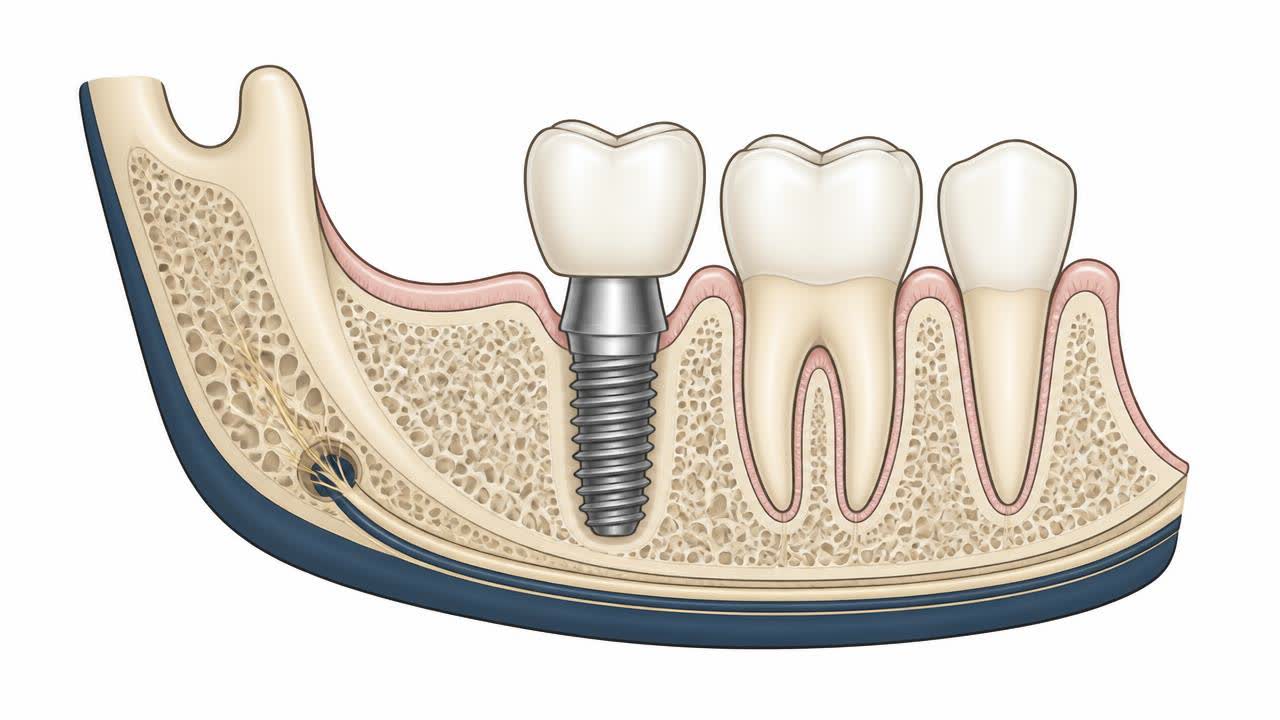
At a glance
- An implant supported overdenture is a removable denture that clips onto two or more implants placed in the jaw, rather than relying purely on suction or adhesive against the gums as a conventional denture does.
- Various attachment systems can be used to connect the denture to the implants, including ball attachments, locator attachments, or a bar that joins multiple implants together, over which the denture clips securely.
- Patients frequently report a considerable improvement in chewing efficiency and confidence, since the denture no longer shifts unpredictably during meals or conversation.
- The denture should be removed and cleaned daily, and the attachment components require periodic replacement as they naturally wear down with repeated use over the years, which your dentist will monitor and manage during routine…
What Is an Implant Supported Overdenture
An implant supported overdenture is a removable denture that clips onto two or more implants placed in the jaw, rather than relying purely on suction or adhesive against the gums as a conventional denture does. This dramatically reduces movement and improves confidence when eating and speaking.
It is often chosen as a middle-ground solution between a conventional removable denture and a fully fixed implant bridge, offering many of the stability benefits of implants while remaining removable for cleaning, and generally requiring fewer implants than a fixed solution.
How the Attachment System Works
Various attachment systems can be used to connect the denture to the implants, including ball attachments, locator attachments, or a bar that joins multiple implants together, over which the denture clips securely. Your dentist will recommend the system best suited to your implant number and jaw anatomy.
These attachments allow the denture to snap firmly into place during eating and speaking, yet still be removed each night by the patient for thorough cleaning, offering a practical balance between stability and ease of maintenance for many patients, particularly older adults.
Benefits Over a Conventional Denture
Patients frequently report a considerable improvement in chewing efficiency and confidence, since the denture no longer shifts unpredictably during meals or conversation. This can be particularly transformative for patients who have struggled with a loose lower denture, historically one of the most difficult dental problems to manage well.
Implant supported overdentures also help slow the rate of bone loss compared to a conventional denture, since the implants continue to stimulate the underlying bone even though the prosthesis itself remains removable.
Care and Long-Term Expectations
The denture should be removed and cleaned daily, and the attachment components require periodic replacement as they naturally wear down with repeated use over the years, which your dentist will monitor and manage during routine visits.
Implants supporting the overdenture require the same diligent hygiene as any other dental implant to prevent peri-implantitis, including cleaning around the implant necks daily and attending regular professional reviews to ensure the entire system continues functioning well.
Questions patients ask us
- How many implants are needed for an overdenture?
- Typically two implants are used to support a lower overdenture, while the upper jaw may require four or more due to generally softer bone, though the exact number depends on individual bone quality, jaw shape, and your dentist's clinical assessment.
- Is an overdenture as stable as a fixed bridge?
- An overdenture offers significantly more stability than a conventional denture but is generally still slightly less stable than a fully fixed implant bridge, since it remains removable. Many patients find this an excellent balance between function, cost, and ease of cleaning.
- Can I convert my existing denture into an overdenture?
- In some cases, an existing well-fitting denture can be adapted to accommodate implant attachments, though a purpose-built new denture often provides a better long-term fit and function. Your dentist can assess your current denture's suitability for conversion.
- How often do the attachments need replacing?
- The small retentive components inside the denture that clip onto the implants typically wear down gradually and may need replacement roughly once a year or so, depending on usage, which is a normal and expected part of long-term maintenance.
Sources and further reading
Guidance from professional and public health bodies. Clinical decisions here are made on your own examination and radiographs.
- 1.ITI Treatment Guide series and consensus statements — International Team for Implantology (ITI)
- 2.Consensus reports on implant dentistry — European Association for Osseointegration
- 3.Prosthodontic and edentulous-care patient guidance — American College of Prosthodontists
- 4.Oral health — fact sheet and global status report — World Health Organization
- 5.Policy statements and oral health definitions — FDI World Dental Federation
- 6.Dental health — conditions, treatments and patient guidance — NHS (UK)
- 7.Systematic reviews of oral and dental interventions — Cochrane Oral Health
- 8.Regulatory framework and dental education standards in India — Dental Council of India
When to see us
Get examined without waiting if any of the following applies to you:
- Pain, looseness or pus around an implant or a fixed bridge
- A crown, bridge or denture that has fractured or come away
- Gum swelling that keeps returning around the same restoration
Get a written plan and cost before you commit
If this is what you are dealing with, the next step is a consultation with radiographs — implants & missing teeth cases are seen by the specialist who handles that field. You get a written plan and staged cost before anything begins.
reception@dramitsharmahospital.comThis article is general education and does not replace an in-person examination, radiographs or a diagnosis by a qualified dentist.
Clinical terms in this article
Related in Implants & Missing Teeth
Missing Teeth: Comparing Dentures, Bridges and Implant Options
What happens if a missing tooth is left unreplaced, and how dentures, bridges and implants compare on comfort, longevity and bone health.
Dental Implants: A Complete Guide
How titanium implants replace missing teeth, who qualifies, the step-by-step timeline and how long they last.
Full Mouth Rehabilitation
Rebuilding a worn, collapsed or heavily damaged dentition with a sequenced, whole-mouth treatment plan.
Peri-Implant Mucositis Symptoms and Early Intervention
Peri-implant mucositis is a plaque-induced, reversible inflammatory lesion affecting the soft tissues surrounding a dental implant without bone loss. Prompt professional debridement, risk-factor modification, and meticulous biofilm control prevent progression to irreversible peri-implantitis.
Peri-Implantitis Symptoms Bone Loss and Implant Salvage
Peri-implantitis is an inflammatory condition causing progressive marginal bone loss around dental implants. Early detection, thorough decontamination, and advanced surgical salvage techniques can arrest bone destruction, resolve inflammation, and preserve implant stability.
Root Canal Retreatment vs Tooth Extraction and Implant
This clinical guide evaluates root canal retreatment versus tooth extraction and dental implant placement. Learn about biological tooth preservation, anatomical considerations, procedural steps, longevity, recovery expectations, and diagnostic criteria to make an informed oral healthcare decision.