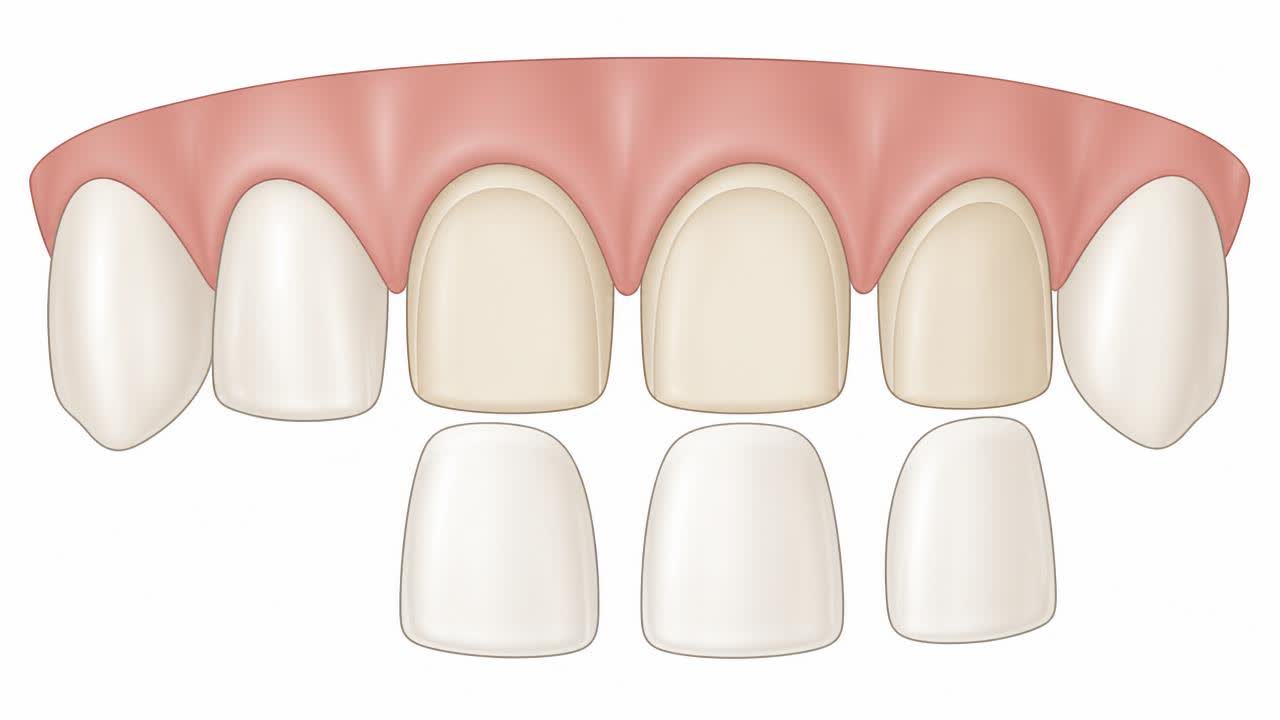
At a glance
- A crown is a custom-made cap that covers an entire tooth above the gum line, restoring its shape, strength and appearance once too much natural structure has been lost to support a simple filling.
- A bridge replaces one or more missing teeth by fusing an artificial tooth, called a pontic, to crowns placed on the natural teeth adjacent to the gap.
- Zirconia is now one of the most widely used crown and bridge materials, valued for its strength, closely matched tooth-like translucency, and biocompatibility with gum tissue.
- The tooth or teeth are first prepared by removing a thin, precisely measured layer of the outer surface to make room for the crown material without making the final tooth feel bulky.
- Crowns and bridges are cleaned like natural teeth, with the added step of a floss threader, interdental brush or water flosser to clean underneath the pontic of a bridge, an area that traps food but cannot be reached by an…
What a dental crown does
A crown is a custom-made cap that covers an entire tooth above the gum line, restoring its shape, strength and appearance once too much natural structure has been lost to support a simple filling. Common reasons for needing a crown include a large cavity, a tooth cracked by biting force, a tooth that has become brittle after root canal treatment, or simply a tooth badly worn down over many years.
Crowns are also used cosmetically to reshape a misshapen or heavily discoloured tooth, though for purely cosmetic goals on otherwise healthy teeth, thinner veneers are usually a more conservative choice since they preserve more of the natural tooth underneath.
What a dental bridge does
A bridge replaces one or more missing teeth by fusing an artificial tooth, called a pontic, to crowns placed on the natural teeth adjacent to the gap. Once cemented, a bridge functions and feels much like natural teeth, is not removed for cleaning, and is typically completed over two to three visits.
Bridges are a well-established option where the supporting teeth on either side already need crowns for their own reasons, such as large existing fillings or previous root canal treatment, since in that situation reshaping them to support a bridge adds relatively little extra intervention. Where the neighbouring teeth are otherwise perfectly healthy, a dental implant is often considered as an alternative that avoids reducing sound tooth structure.
Materials used today
Zirconia is now one of the most widely used crown and bridge materials, valued for its strength, closely matched tooth-like translucency, and biocompatibility with gum tissue. Porcelain fused to metal remains a durable, cost-effective option, particularly for back teeth carrying heavy chewing forces, though the underlying metal can sometimes show as a thin dark line at the gum edge over many years.
All-ceramic and lithium disilicate materials such as e.max are chosen where the most natural, translucent appearance is the priority, typically for front teeth. The choice between materials is based on the tooth's position, the forces it will bear, and the aesthetic priority for that specific tooth, and this is discussed individually rather than applying one material to every case.
The step-by-step process
The tooth or teeth are first prepared by removing a thin, precisely measured layer of the outer surface to make room for the crown material without making the final tooth feel bulky. An impression or digital intraoral scan then captures the exact shape needed, and a temporary crown or bridge protects the prepared tooth while the permanent restoration is fabricated, usually over one to two weeks.
At the fitting visit, the permanent restoration is checked for fit, bite and colour match before being cemented permanently in place. Same-day CAD-CAM crowns, milled from a digital scan in a single visit, are available in some cases and remove the need for a temporary crown altogether, though they suit certain tooth positions and materials better than others.
Caring for crowns and bridges
Crowns and bridges are cleaned like natural teeth, with the added step of a floss threader, interdental brush or water flosser to clean underneath the pontic of a bridge, an area that traps food but cannot be reached by an ordinary toothbrush. Grinding or clenching habits can chip or loosen a crown over time, and a nightguard is often recommended if this is identified as a risk.
With good hygiene and regular dental review, a well-made crown or bridge commonly lasts ten to fifteen years or longer, though the tooth underneath still needs the same attention as any natural tooth, since decay can still develop at the margin where the crown meets the gum if plaque is allowed to build up there.
Questions patients ask us
- Does getting a crown hurt?
- The tooth is numbed with local anaesthesia before any preparation, so the process is not painful. Mild sensitivity to hot or cold for a short period afterwards is normal and usually settles once the permanent crown is fitted.
- How long does a crown or bridge last?
- With good oral hygiene and regular check-ups, ten to fifteen years or more is common, though this varies with the material used, the forces the tooth bears, and how well the margin is kept clean.
- Is a bridge or an implant better for a missing tooth?
- Both are valid options. A bridge is usually faster and does not require surgery but involves reshaping the neighbouring teeth, while an implant preserves those teeth untouched and helps maintain the underlying jawbone, at the cost of a longer treatment timeline.
- Can a crown be whitened later if my other teeth are bleached?
- No. Crown material does not respond to whitening gel the way natural enamel does, which is why the shade of a crown is matched carefully at the time it is made, ideally after any planned whitening has already been completed.
Sources and further reading
Guidance from professional and public health bodies. Clinical decisions here are made on your own examination and radiographs.
- 1.Whitening, bonding and veneers — patient information — American Dental Association
- 2.Guidance on tooth whitening and cosmetic dental treatment — British Dental Association
- 3.Oral health — fact sheet and global status report — World Health Organization
- 4.Policy statements and oral health definitions — FDI World Dental Federation
- 5.Dental health — conditions, treatments and patient guidance — NHS (UK)
- 6.Systematic reviews of oral and dental interventions — Cochrane Oral Health
- 7.Regulatory framework and dental education standards in India — Dental Council of India
When to see us
Get examined without waiting if any of the following applies to you:
- Sensitivity or pain that continues for more than a few days after cosmetic work
- A veneer, crown or bonded restoration that has chipped, debonded or feels high in the bite
- Gum inflammation or dark margins developing at the edge of a restoration
Get a written plan and cost before you commit
If this is what you are dealing with, the next step is a consultation with radiographs — cosmetic & smile design cases are seen by the specialist who handles that field. You get a written plan and staged cost before anything begins.
reception@dramitsharmahospital.comThis article is general education and does not replace an in-person examination, radiographs or a diagnosis by a qualified dentist.
Clinical terms in this article
Related in Cosmetic & Smile Design
Teeth Whitening and Tooth Stains: Causes and Treatment Options
Why teeth discolour over time, the difference between surface stains and deeper discolouration, and how professional whitening compares with home options.
Smile Makeover and Digital Smile Design
How veneers, bonding, whitening and gum contouring are combined into one planned cosmetic outcome.
Teeth Whitening: What Actually Works
In-office versus home whitening, realistic expectations, sensitivity management and what whitening cannot fix.
Black Triangles Between Teeth Causes and Treatment
Open gingival embrasures, commonly called black triangles between teeth and gums, occur when the interdental papilla recedes. Explore the anatomical causes, clinical classifications, restorative and orthodontic treatments, and long-term periodontal maintenance strategies.
Internal Tooth Bleaching for Discolored Nonvital Teeth
Internal tooth bleaching after root canal treatment is a conservative endodontic procedure that lightens intrinsically discoloured, non-vital teeth from within the pulp chamber, restoring natural aesthetics without requiring extensive structural removal for crowns or veneers.
Sliding Genioplasty Chin Surgery for Facial Balance Improvement
Sliding genioplasty is an osseous surgical procedure that repositions the mandibular symphysis to improve facial balance and airway competence. This clinical guide outlines surgical techniques, the sliding genioplasty recovery timeline, risks, and evidence-based postoperative management.