At a glance
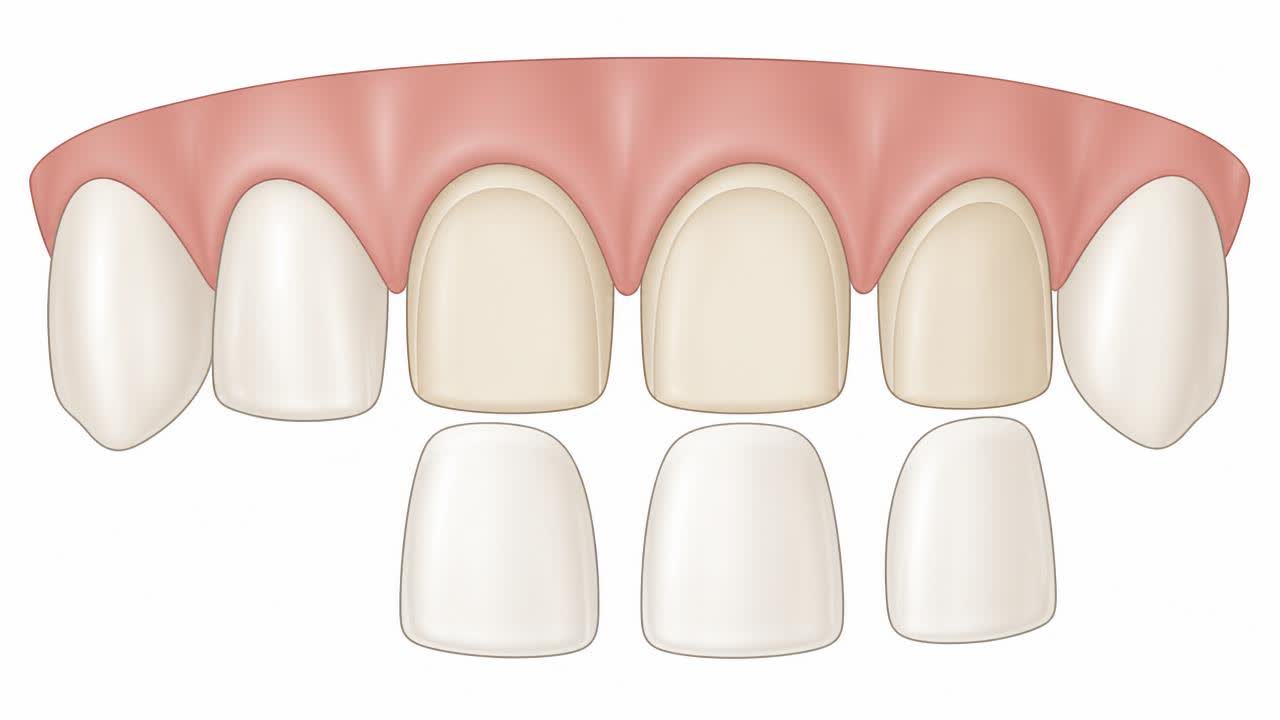
- Porcelain veneers are wafer-thin shells, typically less than a millimetre thick, bonded to the visible front surface of a tooth.
- Treatment usually begins with shade selection and a mock-up so you can preview the intended result.
- Well made porcelain veneers can last well over a decade with good care, and porcelain itself resists staining from tea, coffee and turmeric-based foods far better than natural enamel or composite resin.
- Compared with composite bonding, porcelain veneers cost more and require some tooth preparation, but they hold colour and shape considerably longer and resist scratching from daily brushing.
What Porcelain Veneers Correct
Porcelain veneers are wafer-thin shells, typically less than a millimetre thick, bonded to the visible front surface of a tooth. They are commonly used to address discolouration that does not respond to whitening, chipped or worn edges, small gaps between front teeth, and teeth that are slightly rotated or narrow compared with their neighbours.
Because the shells are custom made in a dental laboratory from a mould or digital scan of your teeth, they can be shaped to correct several of these issues simultaneously across a set of front teeth, creating a coordinated and natural looking result rather than fixing one tooth in isolation.
The Treatment Process
Treatment usually begins with shade selection and a mock-up so you can preview the intended result. A thin layer of enamel, often less than half a millimetre, is then gently removed from the front surface of each tooth to make room for the veneer without making the tooth look bulky.
An impression or digital scan is taken and sent to the laboratory, and a temporary veneer is placed to protect the prepared tooth while the permanent shells are fabricated, which usually takes one to two weeks. At the fitting appointment, each veneer is tried in individually to check colour and fit before being permanently bonded using a light-cured resin cement.
The bonding step is technique sensitive and benefits from a dry, well isolated field, which is one reason we recommend having veneers placed in a proper clinical setting rather than rushed same-day arrangements sometimes advertised elsewhere.
Veneers Versus Other Options
Compared with composite bonding, porcelain veneers cost more and require some tooth preparation, but they hold colour and shape considerably longer and resist scratching from daily brushing. Compared with crowns, veneers preserve more of the natural tooth since they typically cover only the front surface rather than encasing the whole tooth.
Your dentist will discuss which option suits your specific combination of tooth colour, existing damage, bite pattern and budget, since veneers are not always the most conservative or appropriate choice for every situation, particularly where a tooth has extensive decay or a large existing filling.
Longevity and Realistic Expectations
Well made porcelain veneers can last well over a decade with good care, and porcelain itself resists staining from tea, coffee and turmeric-based foods far better than natural enamel or composite resin. However, the bonded margin where veneer meets tooth can still discolour slightly over many years, particularly if oral hygiene around the gum edge is neglected.
Veneers are not indestructible. Biting directly into hard items such as ice, opening packets with your front teeth, or sustaining a direct blow during sport can chip or dislodge a veneer, so we discuss these precautions clearly during the consultation and recommend a night guard if you grind your teeth.
Questions patients ask us
- Are porcelain veneers reversible?
- No. Because a thin layer of enamel is removed to fit the veneer properly, the process is considered irreversible, and the tooth will need some form of covering restoration going forward. This is discussed thoroughly before treatment starts.
- Will porcelain veneers look like natural teeth?
- Yes, when shade, translucency and shape are matched carefully to your face and remaining teeth, porcelain veneers can look very natural. Skilled shade matching and a proper try-in appointment are key to achieving this result.
- How many veneers do I need for a smile makeover?
- This depends on your goals. Some patients choose veneers for just two front teeth to fix a specific flaw, while others opt for six to ten to achieve a fully coordinated smile. Your dentist will recommend the minimum number needed for a balanced result.
- Can veneers be repaired if one chips?
- Small chips can sometimes be smoothed or repaired with composite resin, but a significant chip usually requires replacing the entire veneer to maintain a consistent appearance with the adjacent teeth.
- Do veneers need special cleaning?
- No special products are required, though we recommend a soft toothbrush and non-abrasive toothpaste, along with regular flossing, to protect the bonded margin at the gum line and maintain the surrounding gum health.
Sources and further reading
Guidance from professional and public health bodies. Clinical decisions here are made on your own examination and radiographs.
- 1.Whitening, bonding and veneers — patient information — American Dental Association
- 2.Guidance on tooth whitening and cosmetic dental treatment — British Dental Association
- 3.Oral health — fact sheet and global status report — World Health Organization
- 4.Policy statements and oral health definitions — FDI World Dental Federation
- 5.Dental health — conditions, treatments and patient guidance — NHS (UK)
- 6.Systematic reviews of oral and dental interventions — Cochrane Oral Health
- 7.Regulatory framework and dental education standards in India — Dental Council of India
When to see us
Get examined without waiting if any of the following applies to you:
- Sensitivity or pain that continues for more than a few days after cosmetic work
- A veneer, crown or bonded restoration that has chipped, debonded or feels high in the bite
- Gum inflammation or dark margins developing at the edge of a restoration
Get a written plan and cost before you commit
If this is what you are dealing with, the next step is a consultation with radiographs — cosmetic & smile design cases are seen by the specialist who handles that field. You get a written plan and staged cost before anything begins.
reception@dramitsharmahospital.comThis article is general education and does not replace an in-person examination, radiographs or a diagnosis by a qualified dentist.
Clinical terms in this article
Related in Cosmetic & Smile Design
Dental Crowns and Bridges: What They Are and When You Need One
How crowns and bridges restore damaged or missing teeth, the materials used, and what the process and aftercare involve.
Teeth Whitening and Tooth Stains: Causes and Treatment Options
Why teeth discolour over time, the difference between surface stains and deeper discolouration, and how professional whitening compares with home options.
Smile Makeover and Digital Smile Design
How veneers, bonding, whitening and gum contouring are combined into one planned cosmetic outcome.
Teeth Whitening: What Actually Works
In-office versus home whitening, realistic expectations, sensitivity management and what whitening cannot fix.
Black Triangles Between Teeth Causes and Treatment
Open gingival embrasures, commonly called black triangles between teeth and gums, occur when the interdental papilla recedes. Explore the anatomical causes, clinical classifications, restorative and orthodontic treatments, and long-term periodontal maintenance strategies.
Internal Tooth Bleaching for Discolored Nonvital Teeth
Internal tooth bleaching after root canal treatment is a conservative endodontic procedure that lightens intrinsically discoloured, non-vital teeth from within the pulp chamber, restoring natural aesthetics without requiring extensive structural removal for crowns or veneers.