At a glance
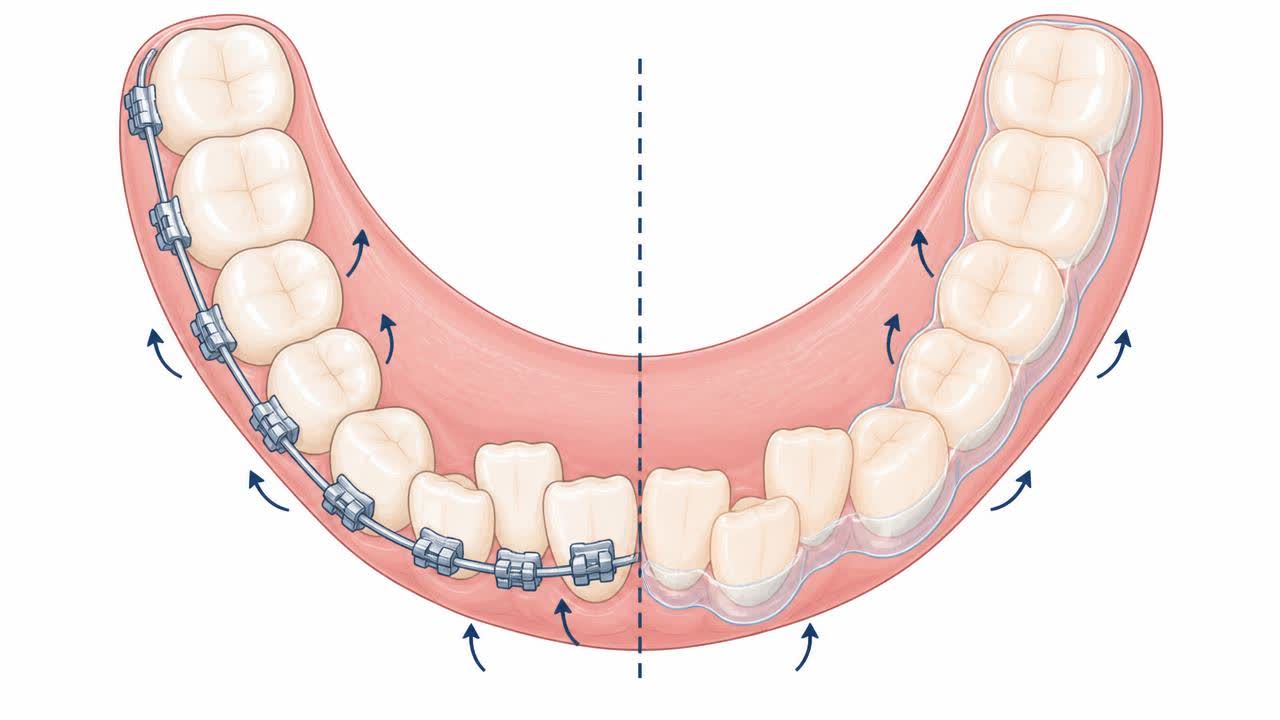
- Metal braces remain the gold standard for correcting complex alignment issues, including severe crowding and bite irregularities.
- Clear aligners offer a discreet, removable alternative to fixed hardware.
- The choice between these two modalities often hinges on the severity of the malocclusion.
- Consider your daily routine when choosing your appliance.
- Ultimately, the decision rests on a balance between clinical necessity, aesthetic preference, and your ability to commit to the required care.
Understanding Traditional Metal Braces
Metal braces remain the gold standard for correcting complex alignment issues, including severe crowding and bite irregularities. These appliances consist of high-grade stainless steel brackets and wires, which allow our orthodontists at Dr. Amit Sharma Super Speciality Dental Hospital to exert precise, controlled force on your teeth. Their durability ensures consistent movement, making them highly effective for even the most demanding cases.
While they are highly functional, some patients find the aesthetic profile of metal braces challenging. However, modern advancements have made them significantly smaller and more comfortable than in previous decades. By choosing traditional braces, you are opting for a time-tested treatment modality that delivers predictable results, provided that you maintain rigorous oral hygiene practices and attend all scheduled adjustment appointments at our Jaipur facility.
Exploring Clear Aligner Technology
Clear aligners offer a discreet, removable alternative to fixed hardware. These custom-made, transparent trays are engineered to move your teeth gradually, providing an aesthetically pleasing experience throughout your treatment journey. Patients often appreciate the ability to remove them for eating, drinking, and important social occasions, which can significantly enhance comfort and convenience during the daily management of their orthodontic correction process.
Success with aligners relies heavily on patient compliance. You must wear the trays for at least 22 hours per day to achieve the desired clinical outcomes. If you possess the discipline to follow this regimen, aligners can be exceptionally effective for mild to moderate alignment concerns. Our team will perform a comprehensive assessment at our clinic to determine if you are a suitable candidate for this specific technology.
Comparing Clinical Efficacy
The choice between these two modalities often hinges on the severity of the malocclusion. Complex cases involving jaw alignment or significant rotational movements often require the constant, anchored force that only metal braces can provide. Conversely, if your goals involve correcting minor spacing or mild crowding, aligners often present an excellent, less invasive solution that fits seamlessly into your busy professional and personal lifestyle.
Our clinicians evaluate the specific biological requirements of your teeth before recommending a path. We consider factors like root structure, bone health, and the complexity of the tooth movement needed. At Dr. Amit Sharma Super Speciality Dental Hospital, we prioritise your long-term dental health over mere aesthetic goals, ensuring that whichever method is chosen, the structural integrity of your bite is preserved and enhanced effectively.
Making Your Final Decision
Ultimately, the decision rests on a balance between clinical necessity, aesthetic preference, and your ability to commit to the required care. Both metal braces and clear aligners are capable of delivering a healthy, functional smile when overseen by an expert orthodontist. It is essential to weigh the trade-offs of each system carefully to ensure that your chosen path aligns with your long-term goals for dental health.
We invite you to schedule a consultation at Dr. Amit Sharma Super Speciality Dental Hospital in Jaipur. Our experts will conduct a thorough examination and discuss your options in detail, ensuring you feel confident in your choice. Contact us at 9314403502 to begin your journey toward a perfectly aligned, healthy, and beautiful smile with the guidance of our experienced and dedicated dental specialists.
Lifestyle and Maintenance Considerations
Consider your daily routine when choosing your appliance. Metal braces require specific cleaning tools like interdental brushes to navigate around brackets and wires, whereas aligners require you to brush and floss thoroughly after every meal before replacing the trays. Failure to maintain cleanliness with either method can lead to plaque accumulation, gum inflammation, and in some instances, permanent white spots on the enamel surfaces.
For patients with active lifestyles or those involved in contact sports, removable aligners offer a significant advantage, provided they are stored safely during activities. Metal braces, however, are always present, offering a permanent solution that requires less active management but may necessitate protective gear. We encourage you to discuss these lifestyle factors with our team to ensure your orthodontic choice supports your daily commitments and comfort.
Questions patients ask us
- Are metal braces more effective than aligners?
- While both are effective, metal braces offer greater control for complex, severe cases involving significant bite corrections or major tooth movements. Clear aligners are excellent for mild to moderate issues but require high patient compliance to be as effective as fixed appliances in challenging clinical scenarios.
- Can I switch from metal braces to aligners mid-treatment?
- Switching systems is rare and generally not recommended as it complicates the treatment plan. It is best to stick with your initial choice throughout the process to ensure consistent, predictable results. We will help you select the most appropriate option from the start based on your needs.
- Do aligners cause more discomfort than braces?
- Both methods cause some initial discomfort as they apply pressure to move teeth. Aligners may feel tighter during the first few days of a new tray, while braces may irritate cheeks initially. Both symptoms are manageable and typically subside within a few days as your mouth adjusts.
- How long does each treatment typically take?
- Treatment duration varies significantly based on the complexity of your case. Generally, both options take between 12 to 24 months, though minor corrections can be faster. Our orthodontists will provide an estimated timeline during your initial assessment at Dr. Amit Sharma Super Speciality Dental Hospital in Jaipur.
Sources and further reading
Guidance from professional and public health bodies. Clinical decisions here are made on your own examination and radiographs.
- 1.Orthodontic treatment and retention — patient resources — American Association of Orthodontists
- 2.Patient information leaflets on appliances and retention — British Orthodontic Society
- 3.Oral health — fact sheet and global status report — World Health Organization
- 4.Policy statements and oral health definitions — FDI World Dental Federation
- 5.Dental health — conditions, treatments and patient guidance — NHS (UK)
- 6.Systematic reviews of oral and dental interventions — Cochrane Oral Health
- 7.Regulatory framework and dental education standards in India — Dental Council of India
When to see us
Get examined without waiting if any of the following applies to you:
- A broken bracket, poking wire or appliance causing ulceration
- A tooth that becomes painful, loose or discoloured during treatment
- Jaw joint pain, locking or a bite that has changed suddenly
Get a written plan and cost before you commit
If this is what you are dealing with, the next step is a consultation with radiographs — orthodontics cases are seen by the specialist who handles that field. You get a written plan and staged cost before anything begins.
reception@dramitsharmahospital.comThis article is general education and does not replace an in-person examination, radiographs or a diagnosis by a qualified dentist.
Clinical terms in this article
Related in Orthodontics
Aligners and Braces: Choosing the Right Option
Metal, ceramic and clear aligner treatment compared, duration, visibility, cost and suitability.
Tooth Extraction for Braces or Severe Crowding Issues
Orthodontic extractions involve the planned removal of select teeth to resolve severe crowding, correct bimaxillary protrusion, and balance dentoalveolar proportions. This clinical guide details diagnostic indications, extraction patterns, procedural steps, recovery, risks, and evidence-based non-extraction alternatives.
Maxillary Osteotomy for Open Bite Alignment and Correction
Maxillary osteotomy for open bite corrects severe vertical skeletal discrepancies through surgical repositioning of the upper jaw. Combined with orthodontics, this procedure restores chewing function, improves speech articulation, and ensures long-term occlusal and facial stability.
Surgically Assisted Rapid Palatal Expansion for Adult Palate Widening
Surgically assisted rapid palatal expansion (SARPE) is a combined orthodontic and surgical treatment designed to correct severe transverse maxillary deficiency in skeletally mature adults, widening the narrow upper jaw to restore functional occlusion, stability, and airway volume.
Surgical Exposure and Bracket Bonding for Impacted Canine Teeth
This clinical guide details impacted canine exposure surgery and bracket bonding. It explains anatomical causes, CBCT diagnostic pathways, open versus closed surgical techniques, orthodontic traction mechanisms, recovery protocols, and evidence-based strategies to manage complications.
Overbite vs Overjet: Key Differences and Correction Methods
This clinical guide clarifies the distinction between overbite (vertical overlap) and overjet (horizontal protrusion). It examines their aetiology, diagnostic pathways, classification, and evidence-based orthodontic and surgical correction methods across paediatric and adult populations.