At a glance
- It is quite common for teeth to shift slightly after traditional braces treatment if retainers haven't been worn consistently, a phenomenon known as orthodontic relapse.
- Using clear aligners to correct relapse is incredibly convenient and discreet.
- To correct a relapse, we start with a new 3D scan of your teeth.
- Just like in your first orthodontic journey, your consistency is vital for the success of correcting a relapse.
- Once you have successfully realigned your teeth with clear aligners, the final, most important step is to commit to lifelong retention.
Why Teeth Shift After Braces
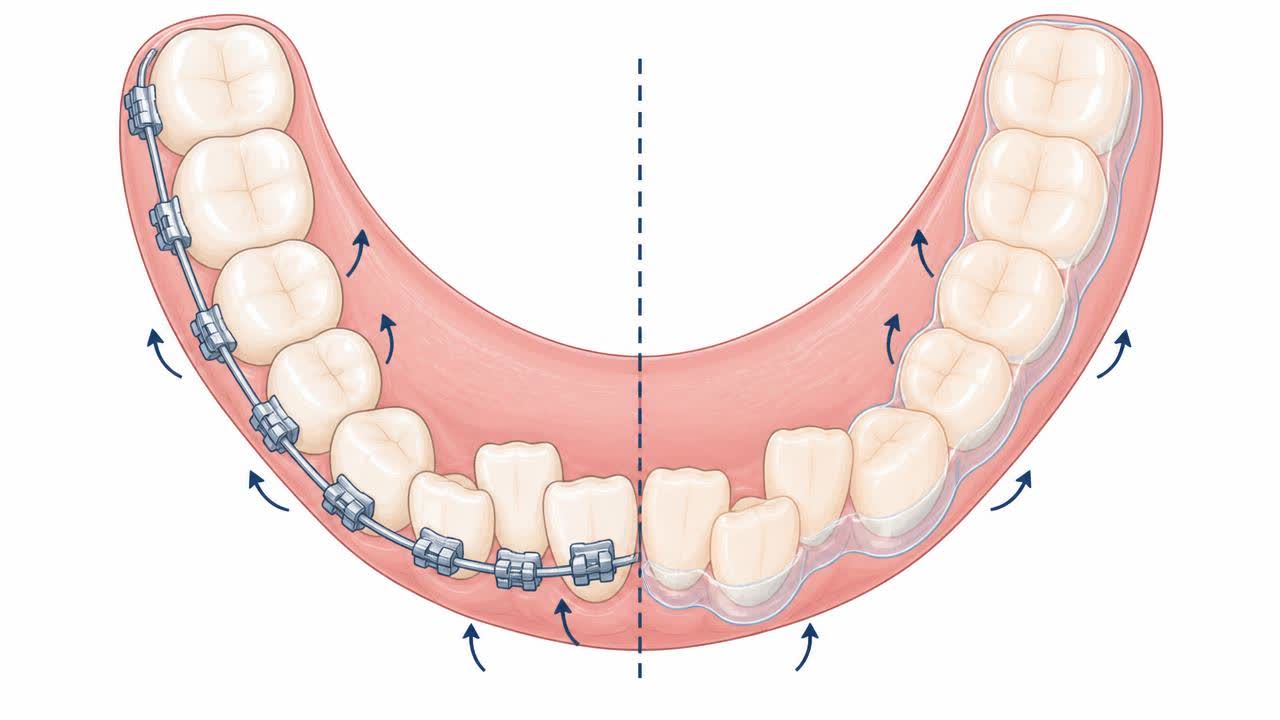
It is quite common for teeth to shift slightly after traditional braces treatment if retainers haven't been worn consistently, a phenomenon known as orthodontic relapse. This can be frustrating, especially after you've already put in the time and effort to straighten your smile. Fortunately, clear aligners are a perfect solution for fixing this kind of minor to moderate relapse.
Aligners can gently guide your teeth back into their ideal, previously-achieved positions. Because they are so precise, they are perfect for this type of 'fine-tuning.' Whether it's a few teeth that have rotated or a small gap that has opened up, we can create a custom series of aligners that will efficiently move your teeth back to their best alignment in a relatively short amount of time.
The Convenience of Aligners for Relapse
Using clear aligners to correct relapse is incredibly convenient and discreet. You don't need to go back to traditional metal braces. Instead, you get a custom, comfortable series of nearly invisible trays that you can easily incorporate into your daily life. It is a much more modern and less intrusive way to regain the smile you worked so hard to achieve.
The treatment is often faster than the original orthodontic journey, as the teeth have already been straightened and just need to be guided back to their ideal positions. Our team at Dr. Amit Sharma Super Speciality Dental Hospital can quickly assess your situation and create a personalised plan to get your smile back on track with maximum efficiency and minimal disruption to your routine.
Digital Planning for Precision
To correct a relapse, we start with a new 3D scan of your teeth. This allows us to see exactly how they have shifted and to plan the most efficient movement back to your original, ideal alignment. This digital plan gives us a clear and accurate view of the required treatment, ensuring the correction is targeted, predictable, and as gentle as possible.
You will be able to see the plan and understand the timeline needed to fix the relapse. This transparency is a key part of our service. By working with this advanced digital model, we can provide you with the best possible care, ensuring that your second journey to a perfect smile is as smooth, comfortable, and successful as the first one, or even better.
Your Role in the Second Journey
Just like in your first orthodontic journey, your consistency is vital for the success of correcting a relapse. Wearing your aligners for the recommended 22 hours per day ensures your teeth are constantly guided towards their intended position, making the process faster and more effective. Your dedication to your treatment plan is the secret ingredient that drives the correction.
We are here to support you at every stage, providing guidance and answering any questions you may have. We understand the frustration of seeing your hard-won smile relapse, but we also know how effectively this can be fixed. By working together, we can restore your beautiful, straight smile and ensure you are happy with the results for a second time.
Lifetime Commitment to Retention
Once you have successfully realigned your teeth with clear aligners, the final, most important step is to commit to lifelong retention. This time, we want to make sure your results are permanent. We will provide you with new, custom retainers, and it is vital that you wear them as directed to prevent any future relapse from happening again.
At our clinic, we are committed to your long-term success. We will provide you with all the guidance and support needed to make retention an easy, habitual part of your life. Your smile is a precious asset, and we are proud to have helped you restore it. By committing to this final step, you ensure your beautiful, perfectly straight smile stays that way for a lifetime.
Questions patients ask us
- Why did my teeth shift after having braces?
- Teeth have a natural tendency to shift throughout life. If retainers aren't worn consistently after braces, they will inevitably drift towards their original positions. This is why lifelong retention is so important.
- Is it difficult to fix relapse with aligners?
- Not at all. Clear aligners are excellent for correcting minor to moderate relapse. Because your teeth have already been straightened, the correction is often faster and much more convenient than your initial treatment.
- Do I need to wear braces again?
- Definitely not! You can enjoy all the benefits of a modern, nearly invisible treatment with clear aligners. No wires or metal brackets are needed to fix your orthodontic relapse.
- What can I do to prevent another relapse?
- The only way to ensure your teeth stay straight for life is to commit to wearing your retainers as prescribed after your correction is finished. It is the most critical step for your long-term success.
Sources and further reading
Guidance from professional and public health bodies. Clinical decisions here are made on your own examination and radiographs.
- 1.Orthodontic treatment and retention — patient resources — American Association of Orthodontists
- 2.Patient information leaflets on appliances and retention — British Orthodontic Society
- 3.Oral health — fact sheet and global status report — World Health Organization
- 4.Policy statements and oral health definitions — FDI World Dental Federation
- 5.Dental health — conditions, treatments and patient guidance — NHS (UK)
- 6.Systematic reviews of oral and dental interventions — Cochrane Oral Health
- 7.Regulatory framework and dental education standards in India — Dental Council of India
When to see us
Get examined without waiting if any of the following applies to you:
- A broken bracket, poking wire or appliance causing ulceration
- A tooth that becomes painful, loose or discoloured during treatment
- Jaw joint pain, locking or a bite that has changed suddenly
Get a written plan and cost before you commit
If this is what you are dealing with, the next step is a consultation with radiographs — orthodontics cases are seen by the specialist who handles that field. You get a written plan and staged cost before anything begins.
reception@dramitsharmahospital.comThis article is general education and does not replace an in-person examination, radiographs or a diagnosis by a qualified dentist.
Clinical terms in this article
Related in Orthodontics
Aligners and Braces: Choosing the Right Option
Metal, ceramic and clear aligner treatment compared, duration, visibility, cost and suitability.
Tooth Extraction for Braces or Severe Crowding Issues
Orthodontic extractions involve the planned removal of select teeth to resolve severe crowding, correct bimaxillary protrusion, and balance dentoalveolar proportions. This clinical guide details diagnostic indications, extraction patterns, procedural steps, recovery, risks, and evidence-based non-extraction alternatives.
Maxillary Osteotomy for Open Bite Alignment and Correction
Maxillary osteotomy for open bite corrects severe vertical skeletal discrepancies through surgical repositioning of the upper jaw. Combined with orthodontics, this procedure restores chewing function, improves speech articulation, and ensures long-term occlusal and facial stability.
Surgically Assisted Rapid Palatal Expansion for Adult Palate Widening
Surgically assisted rapid palatal expansion (SARPE) is a combined orthodontic and surgical treatment designed to correct severe transverse maxillary deficiency in skeletally mature adults, widening the narrow upper jaw to restore functional occlusion, stability, and airway volume.
Surgical Exposure and Bracket Bonding for Impacted Canine Teeth
This clinical guide details impacted canine exposure surgery and bracket bonding. It explains anatomical causes, CBCT diagnostic pathways, open versus closed surgical techniques, orthodontic traction mechanisms, recovery protocols, and evidence-based strategies to manage complications.
Overbite vs Overjet: Key Differences and Correction Methods
This clinical guide clarifies the distinction between overbite (vertical overlap) and overjet (horizontal protrusion). It examines their aetiology, diagnostic pathways, classification, and evidence-based orthodontic and surgical correction methods across paediatric and adult populations.