At a glance
- Lingual braces work on the same fundamental principle as traditional braces, using brackets and an archwire to apply controlled pressure that gradually moves teeth into alignment.
- Because the tongue rests against the back of the teeth throughout the day, most patients notice some initial irritation to the tongue and changes to their speech, particularly with sounds that require the tongue to touch the roof…
- Lingual braces can treat a wide range of alignment and bite issues, similar to traditional front-mounted braces, though certain very complex tooth movements may be technically more challenging from the back surface.
- Lingual braces are often selected by adults in public-facing professions, performers, and anyone who wants the benefits of fixed orthodontic treatment without any visible sign of an appliance during the treatment period.
What Are Lingual Braces
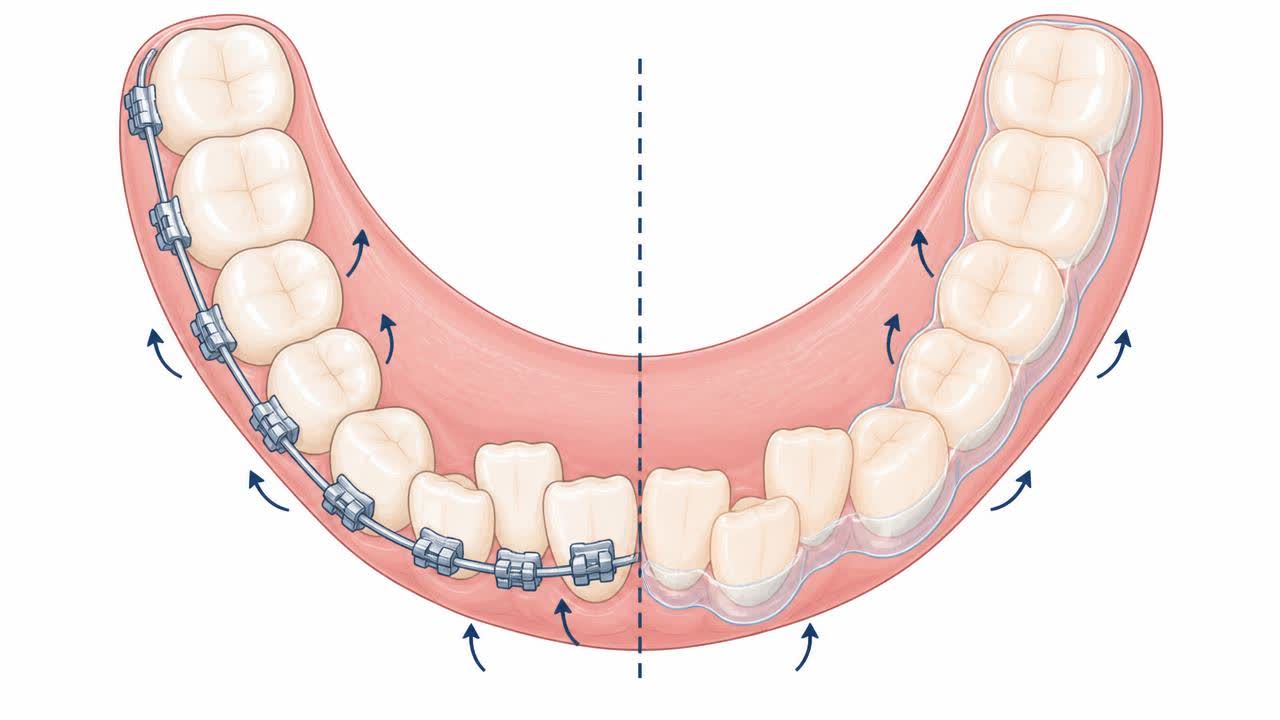
Lingual braces work on the same fundamental principle as traditional braces, using brackets and an archwire to apply controlled pressure that gradually moves teeth into alignment. The distinguishing feature is that the brackets are bonded to the back, or tongue-facing, surface of the teeth rather than the front, making the appliance completely invisible when you smile or speak.
Because each bracket must be custom-fitted to the unique contours of the back surface of your teeth, lingual braces require detailed digital scanning and precision manufacturing. This makes them a highly specialised treatment option, generally recommended for patients who want maximum discretion and are willing to accept a somewhat longer adaptation period compared to front-mounted appliances.
The Adjustment Period
Because the tongue rests against the back of the teeth throughout the day, most patients notice some initial irritation to the tongue and changes to their speech, particularly with sounds that require the tongue to touch the roof of the mouth or the back of the front teeth. This typically improves significantly within two to four weeks as the tongue adapts to the presence of the brackets.
Orthodontic wax can be used over any bracket edges that feel sharp during the early weeks, and speaking exercises, such as reading aloud for a few minutes each day, can help speed up adaptation. Most patients find that by the one-month mark, their speech has returned close to normal and daily discomfort has substantially reduced.
Suitability and Treatment Considerations
Lingual braces can treat a wide range of alignment and bite issues, similar to traditional front-mounted braces, though certain very complex tooth movements may be technically more challenging from the back surface. A thorough consultation, including digital scans of both the front and back tooth surfaces, allows your orthodontist to confirm whether lingual placement is suitable for your specific case.
Cleaning around lingual brackets requires slightly more attention, since the back surfaces of teeth are less visible and can be harder to reach with a standard toothbrush. We provide guidance on angled brushing techniques and recommend interdental brushes to help maintain thorough hygiene throughout treatment.
Who Chooses Lingual Braces
Lingual braces are often selected by adults in public-facing professions, performers, and anyone who wants the benefits of fixed orthodontic treatment without any visible sign of an appliance during the treatment period. They are also a popular choice for patients returning for a second course of orthodontic treatment who want a highly discreet option.
Because of the specialised fitting process, lingual braces are generally more involved to place and adjust than front-mounted braces, and appointment times may be slightly longer. Discussing your lifestyle, aesthetic priorities, and budget with your orthodontist will help determine if this is the right fit for you.
Questions patients ask us
- Are lingual braces completely invisible?
- Yes, since the brackets are bonded to the back surface of the teeth, they cannot be seen when you smile, laugh, or speak. This makes lingual braces the most discreet fixed orthodontic option currently available, popular among patients who want treatment without any visible appliance.
- Will lingual braces affect my speech permanently?
- No, any change to speech is temporary and typically resolves within two to four weeks as your tongue adapts to the presence of the brackets. Most patients regain normal speech patterns well before the midpoint of their overall treatment.
- Are lingual braces more expensive than traditional braces?
- Yes, due to the custom manufacturing process and specialised fitting technique required, lingual braces are typically priced higher than metal or ceramic front-mounted braces. Our team can discuss cost details relative to your specific treatment plan during consultation.
- Is it harder to keep lingual braces clean?
- Cleaning requires a bit more care since the brackets sit on the back surface of the teeth, which is naturally less visible and accessible. With the correct brushing angle and use of interdental brushes, most patients maintain good hygiene throughout treatment without significant difficulty.
Sources and further reading
Guidance from professional and public health bodies. Clinical decisions here are made on your own examination and radiographs.
- 1.Orthodontic treatment and retention — patient resources — American Association of Orthodontists
- 2.Patient information leaflets on appliances and retention — British Orthodontic Society
- 3.Oral health — fact sheet and global status report — World Health Organization
- 4.Policy statements and oral health definitions — FDI World Dental Federation
- 5.Dental health — conditions, treatments and patient guidance — NHS (UK)
- 6.Systematic reviews of oral and dental interventions — Cochrane Oral Health
- 7.Regulatory framework and dental education standards in India — Dental Council of India
When to see us
Get examined without waiting if any of the following applies to you:
- A broken bracket, poking wire or appliance causing ulceration
- A tooth that becomes painful, loose or discoloured during treatment
- Jaw joint pain, locking or a bite that has changed suddenly
Get a written plan and cost before you commit
If this is what you are dealing with, the next step is a consultation with radiographs — orthodontics cases are seen by the specialist who handles that field. You get a written plan and staged cost before anything begins.
reception@dramitsharmahospital.comThis article is general education and does not replace an in-person examination, radiographs or a diagnosis by a qualified dentist.
Clinical terms in this article
Related in Orthodontics
Aligners and Braces: Choosing the Right Option
Metal, ceramic and clear aligner treatment compared, duration, visibility, cost and suitability.
Tooth Extraction for Braces or Severe Crowding Issues
Orthodontic extractions involve the planned removal of select teeth to resolve severe crowding, correct bimaxillary protrusion, and balance dentoalveolar proportions. This clinical guide details diagnostic indications, extraction patterns, procedural steps, recovery, risks, and evidence-based non-extraction alternatives.
Maxillary Osteotomy for Open Bite Alignment and Correction
Maxillary osteotomy for open bite corrects severe vertical skeletal discrepancies through surgical repositioning of the upper jaw. Combined with orthodontics, this procedure restores chewing function, improves speech articulation, and ensures long-term occlusal and facial stability.
Surgically Assisted Rapid Palatal Expansion for Adult Palate Widening
Surgically assisted rapid palatal expansion (SARPE) is a combined orthodontic and surgical treatment designed to correct severe transverse maxillary deficiency in skeletally mature adults, widening the narrow upper jaw to restore functional occlusion, stability, and airway volume.
Surgical Exposure and Bracket Bonding for Impacted Canine Teeth
This clinical guide details impacted canine exposure surgery and bracket bonding. It explains anatomical causes, CBCT diagnostic pathways, open versus closed surgical techniques, orthodontic traction mechanisms, recovery protocols, and evidence-based strategies to manage complications.
Overbite vs Overjet: Key Differences and Correction Methods
This clinical guide clarifies the distinction between overbite (vertical overlap) and overjet (horizontal protrusion). It examines their aetiology, diagnostic pathways, classification, and evidence-based orthodontic and surgical correction methods across paediatric and adult populations.