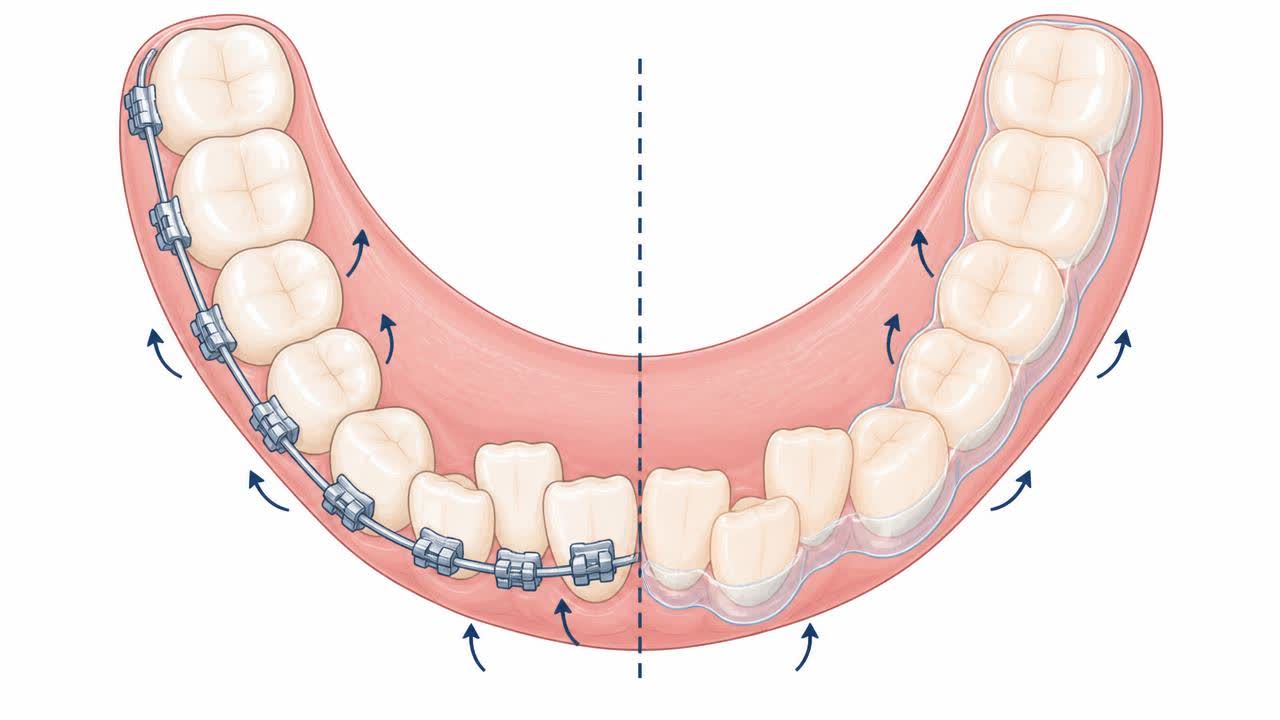
At a glance
- The duration of your clear aligner journey is determined by several factors, primarily the complexity of your original malocclusion.
- Your treatment officially begins with a comprehensive consultation and digital scan.
- Treatment progresses through a series of sequential trays, each designed to move your teeth slightly further.
- We will invite you for periodic reviews to ensure that your treatment is progressing smoothly.
- Once active treatment is completed and your smile is straightened, you enter the retention phase.
Factors Influencing Treatment Duration
The duration of your clear aligner journey is determined by several factors, primarily the complexity of your original malocclusion. Simple cases involving minor spacing or slight crowding may be corrected in as little as six months. More complex cases that require significant tooth movement, correction of bite issues, or the rotation of stubborn teeth will naturally require a longer period of active orthodontic treatment.
Another major factor influencing your timeline is your commitment to the treatment plan. Since aligners are removable, the responsibility rests on you to wear them consistently for the recommended 22 hours per day. Any significant deviation from this routine will result in slower progress and may ultimately extend your total treatment time beyond the initial estimate provided at the start of your care.
Initial Planning and First Aligners
Your treatment officially begins with a comprehensive consultation and digital scan. This data is used to create a 3D treatment plan, which provides us with a clear view of your projected timeline. Once your custom aligners arrive at Dr. Amit Sharma Super Speciality Dental Hospital, we will guide you through the process of how to insert, remove, and care for them appropriately.
The first few weeks are an adjustment period where your mouth gets used to the sensation of the trays. During this stage, you will learn how the trays fit and how to manage the initial mild pressure. This phase is crucial for establishing good habits, such as cleaning your aligners correctly and ensuring you are wearing them for the required hours every day.
Sequential Tray Changes
Treatment progresses through a series of sequential trays, each designed to move your teeth slightly further. Typically, you will change your aligners every one to two weeks, depending on the specific instruction for your case. As you swap to each new tray, you may notice a familiar feeling of pressure, which confirms that your teeth are actively responding to the planned corrective movements.
It is vital to follow the sequence exactly as prescribed. Skipping a set or moving to the next tray prematurely can cause the teeth to not track correctly, which leads to gaps or discomfort. Staying disciplined with your change schedule ensures that your treatment stays on track and that we reach your final aesthetic goals within the projected timeframe initially discussed with you.
Progress Check-ups and Refinements
We will invite you for periodic reviews to ensure that your treatment is progressing smoothly. These check-ups are essential for verifying that your teeth are moving as planned and that the fit of your aligners remains precise. If we detect that progress is slower than anticipated, we can make necessary adjustments to your treatment plan or the way you wear your current set of trays.
Sometimes, at the end of the main treatment series, your teeth may need fine-tuning to reach perfection. This is known as the refinement stage. Refinements are common and are essentially a short, additional set of aligners designed to address minor remaining discrepancies. While they technically add a little time to your overall plan, they ensure that the final result is as precise and aesthetically pleasing as possible.
The Final Stage: Retention
Once active treatment is completed and your smile is straightened, you enter the retention phase. This is just as important as the active alignment phase. To prevent your teeth from shifting back towards their original positions, you must wear a custom-made retainer. Initially, you might wear these full-time, but most patients eventually transition to wearing them only at night for the long term.
At Dr. Amit Sharma Super Speciality Dental Hospital, we emphasise that retention is a lifetime commitment to your new smile. Your bone and gums need time to stabilise in their new locations. By following our retention protocol diligently, you protect your investment and maintain the beautiful, functional results you have worked hard to achieve over the course of your clear aligner treatment journey.
Questions patients ask us
- How many months will my aligner treatment take?
- While many minor treatments are completed within six to nine months, complex cases can take up to eighteen months or more. We will provide a more precise estimate after your initial clinical assessment and digital scan at our Jaipur hospital.
- Can I speed up the treatment process?
- The most effective way to keep your treatment on schedule is to strictly follow our instructions regarding wear time. Attempting to change your aligners faster than recommended is dangerous and will not result in a faster or safer outcome.
- What are 'refinements' in aligner treatment?
- Refinements are additional, secondary sets of aligners provided after your primary series is finished. They are used to make precise, final adjustments to tooth position, ensuring your smile achieves the exact look we planned together at the start.
- Do I have to wear retainers forever?
- Yes, to maintain your straight smile, you will need to wear retainers indefinitely. Teeth naturally tend to shift throughout life, and consistent retainer use is the only way to prevent this relapse and keep your results stable for many years.
Sources and further reading
Guidance from professional and public health bodies. Clinical decisions here are made on your own examination and radiographs.
- 1.Orthodontic treatment and retention — patient resources — American Association of Orthodontists
- 2.Patient information leaflets on appliances and retention — British Orthodontic Society
- 3.Oral health — fact sheet and global status report — World Health Organization
- 4.Policy statements and oral health definitions — FDI World Dental Federation
- 5.Dental health — conditions, treatments and patient guidance — NHS (UK)
- 6.Systematic reviews of oral and dental interventions — Cochrane Oral Health
- 7.Regulatory framework and dental education standards in India — Dental Council of India
When to see us
Get examined without waiting if any of the following applies to you:
- A broken bracket, poking wire or appliance causing ulceration
- A tooth that becomes painful, loose or discoloured during treatment
- Jaw joint pain, locking or a bite that has changed suddenly
Get a written plan and cost before you commit
If this is what you are dealing with, the next step is a consultation with radiographs — orthodontics cases are seen by the specialist who handles that field. You get a written plan and staged cost before anything begins.
reception@dramitsharmahospital.comThis article is general education and does not replace an in-person examination, radiographs or a diagnosis by a qualified dentist.
Clinical terms in this article
Related in Orthodontics
Aligners and Braces: Choosing the Right Option
Metal, ceramic and clear aligner treatment compared, duration, visibility, cost and suitability.
Tooth Extraction for Braces or Severe Crowding Issues
Orthodontic extractions involve the planned removal of select teeth to resolve severe crowding, correct bimaxillary protrusion, and balance dentoalveolar proportions. This clinical guide details diagnostic indications, extraction patterns, procedural steps, recovery, risks, and evidence-based non-extraction alternatives.
Maxillary Osteotomy for Open Bite Alignment and Correction
Maxillary osteotomy for open bite corrects severe vertical skeletal discrepancies through surgical repositioning of the upper jaw. Combined with orthodontics, this procedure restores chewing function, improves speech articulation, and ensures long-term occlusal and facial stability.
Surgically Assisted Rapid Palatal Expansion for Adult Palate Widening
Surgically assisted rapid palatal expansion (SARPE) is a combined orthodontic and surgical treatment designed to correct severe transverse maxillary deficiency in skeletally mature adults, widening the narrow upper jaw to restore functional occlusion, stability, and airway volume.
Surgical Exposure and Bracket Bonding for Impacted Canine Teeth
This clinical guide details impacted canine exposure surgery and bracket bonding. It explains anatomical causes, CBCT diagnostic pathways, open versus closed surgical techniques, orthodontic traction mechanisms, recovery protocols, and evidence-based strategies to manage complications.
Overbite vs Overjet: Key Differences and Correction Methods
This clinical guide clarifies the distinction between overbite (vertical overlap) and overjet (horizontal protrusion). It examines their aetiology, diagnostic pathways, classification, and evidence-based orthodontic and surgical correction methods across paediatric and adult populations.