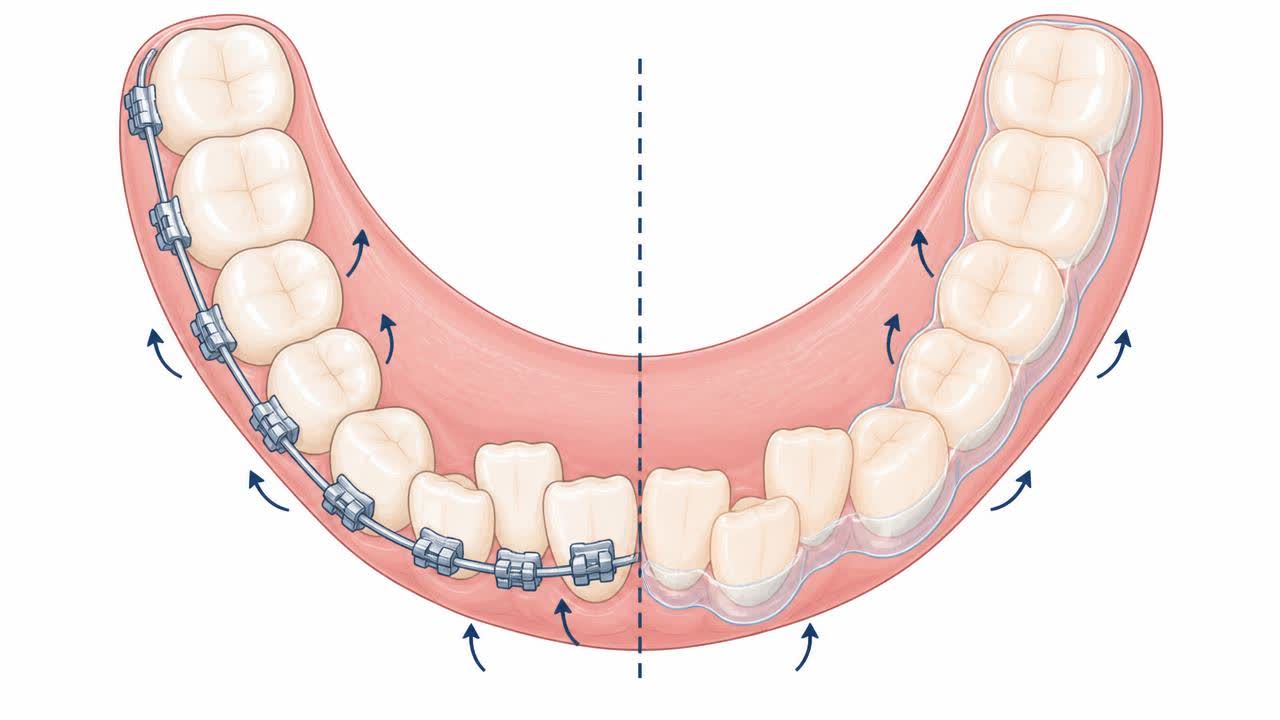
At a glance
- Traditional braces use small elastic or metal ties to hold the archwire against each bracket, which need to be replaced at every adjustment visit.
- Because there are no elastic ties to replace, appointments for self-ligating braces can sometimes be quicker, and some patients report slightly less discomfort during adjustments due to the reduced friction in the system.
- The overall process of getting self-ligating braces fitted is very similar to traditional braces, involving bonding of the brackets followed by placement of an archwire that will be adjusted periodically over the following months.
How Self-Ligating Brackets Work
Traditional braces use small elastic or metal ties to hold the archwire against each bracket, which need to be replaced at every adjustment visit. Self-ligating brackets instead have a built-in sliding or clip mechanism that holds the wire in place directly, eliminating the need for separate ligatures altogether.
This design is thought to reduce friction between the wire and bracket, potentially allowing teeth to move more freely and comfortably as the archwire slides through the mechanism rather than being tightly bound. Both metal and ceramic versions of self-ligating brackets are available, so patients can still choose based on their aesthetic preference.
Potential Benefits Over Traditional Braces
Because there are no elastic ties to replace, appointments for self-ligating braces can sometimes be quicker, and some patients report slightly less discomfort during adjustments due to the reduced friction in the system. The absence of elastic ligatures also removes one potential source of staining, since there are no ties to discolour from food and drink over time.
Some studies and clinical experience suggest self-ligating systems may achieve certain tooth movements with marginally fewer visits in select cases, although overall treatment time is still primarily determined by the complexity of the individual bite rather than the bracket type alone. Your orthodontist will explain realistic expectations for your specific case during consultation.
What to Expect During Treatment
The overall process of getting self-ligating braces fitted is very similar to traditional braces, involving bonding of the brackets followed by placement of an archwire that will be adjusted periodically over the following months. You will still attend regular review appointments, typically every six to eight weeks, though the interval can sometimes be slightly longer than with traditional ligated braces.
Oral hygiene care remains just as important with self-ligating brackets, and the same principles of careful brushing, interdental cleaning, and dietary caution around hard or sticky foods apply. Your orthodontist will guide you through cleaning techniques specific to the self-ligating clip design at your fitting appointment.
Questions patients ask us
- Are self-ligating braces better than traditional braces?
- Self-ligating braces offer certain potential advantages, such as reduced friction and slightly quicker adjustment appointments, but they are not necessarily superior for every case. The best appliance depends on your specific bite, aesthetic preferences, and budget, which your orthodontist will assess during consultation.
- Do self-ligating braces require fewer appointments?
- Some patients may have slightly longer intervals between adjustments, but the overall number of appointments is still largely determined by the complexity of tooth movement required. Your orthodontist will provide a realistic appointment schedule based on your individual treatment plan.
- Are self-ligating braces available in ceramic as well as metal?
- Yes, self-ligating brackets are available in both metal and tooth-coloured ceramic versions, allowing patients to choose based on their preference for discretion alongside the benefits of the self-ligating clip mechanism.
- Is the treatment cost different for self-ligating braces?
- Self-ligating braces are often priced slightly higher than traditional braces due to the specialised bracket design. Our team will provide a clear cost estimate specific to your treatment needs during your consultation visit.
Sources and further reading
Guidance from professional and public health bodies. Clinical decisions here are made on your own examination and radiographs.
- 1.Orthodontic treatment and retention — patient resources — American Association of Orthodontists
- 2.Patient information leaflets on appliances and retention — British Orthodontic Society
- 3.Oral health — fact sheet and global status report — World Health Organization
- 4.Policy statements and oral health definitions — FDI World Dental Federation
- 5.Dental health — conditions, treatments and patient guidance — NHS (UK)
- 6.Systematic reviews of oral and dental interventions — Cochrane Oral Health
- 7.Regulatory framework and dental education standards in India — Dental Council of India
When to see us
Get examined without waiting if any of the following applies to you:
- A broken bracket, poking wire or appliance causing ulceration
- A tooth that becomes painful, loose or discoloured during treatment
- Jaw joint pain, locking or a bite that has changed suddenly
Get a written plan and cost before you commit
If this is what you are dealing with, the next step is a consultation with radiographs — orthodontics cases are seen by the specialist who handles that field. You get a written plan and staged cost before anything begins.
reception@dramitsharmahospital.comThis article is general education and does not replace an in-person examination, radiographs or a diagnosis by a qualified dentist.
Clinical terms in this article
Related in Orthodontics
Aligners and Braces: Choosing the Right Option
Metal, ceramic and clear aligner treatment compared, duration, visibility, cost and suitability.
Tooth Extraction for Braces or Severe Crowding Issues
Orthodontic extractions involve the planned removal of select teeth to resolve severe crowding, correct bimaxillary protrusion, and balance dentoalveolar proportions. This clinical guide details diagnostic indications, extraction patterns, procedural steps, recovery, risks, and evidence-based non-extraction alternatives.
Maxillary Osteotomy for Open Bite Alignment and Correction
Maxillary osteotomy for open bite corrects severe vertical skeletal discrepancies through surgical repositioning of the upper jaw. Combined with orthodontics, this procedure restores chewing function, improves speech articulation, and ensures long-term occlusal and facial stability.
Surgically Assisted Rapid Palatal Expansion for Adult Palate Widening
Surgically assisted rapid palatal expansion (SARPE) is a combined orthodontic and surgical treatment designed to correct severe transverse maxillary deficiency in skeletally mature adults, widening the narrow upper jaw to restore functional occlusion, stability, and airway volume.
Surgical Exposure and Bracket Bonding for Impacted Canine Teeth
This clinical guide details impacted canine exposure surgery and bracket bonding. It explains anatomical causes, CBCT diagnostic pathways, open versus closed surgical techniques, orthodontic traction mechanisms, recovery protocols, and evidence-based strategies to manage complications.
Overbite vs Overjet: Key Differences and Correction Methods
This clinical guide clarifies the distinction between overbite (vertical overlap) and overjet (horizontal protrusion). It examines their aetiology, diagnostic pathways, classification, and evidence-based orthodontic and surgical correction methods across paediatric and adult populations.